Quick Answer
A kitchen remodel cost calculator in 2026 estimates your project by combining square footage, finish level, and regional labor rates into a baseline range, typically $15,000 to $75,000 for most homes, with custom or full-gut projects running higher. These tools are useful for early planning but cannot account for your home’s specific layout, permit requirements, or San Diego-area labor costs, which is why they should be treated as a starting point, not a final quote.
Type “kitchen remodel cost” into any search engine and you’ll get five different answers from five different tools, sometimes varying by $20,000 or more for what sounds like the same project. That’s not a glitch. It’s because every kitchen remodel cost calculator 2026 tool defines “remodel” differently, pulls from different regional datasets, and makes different assumptions about what’s included. Understanding how these calculators actually work, rather than just plugging in numbers and trusting the output, is the difference between a budget that holds up and one that blows up halfway through demolition.
This guide breaks down the math behind kitchen remodel calculators, shows you a real line-item example, and explains exactly how to use these tools so your estimate reflects reality rather than a national average that has little to do with your home.
What Is a Kitchen Remodel Cost Calculator?
A kitchen remodel cost calculator is an online tool that estimates total project cost by combining a few core inputs: kitchen square footage, finish tier (cosmetic, mid-range, or high-end), and sometimes regional labor multipliers. The output is usually a range rather than a single number, because even calculators acknowledge how much variability exists in materials, labor markets, and scope.
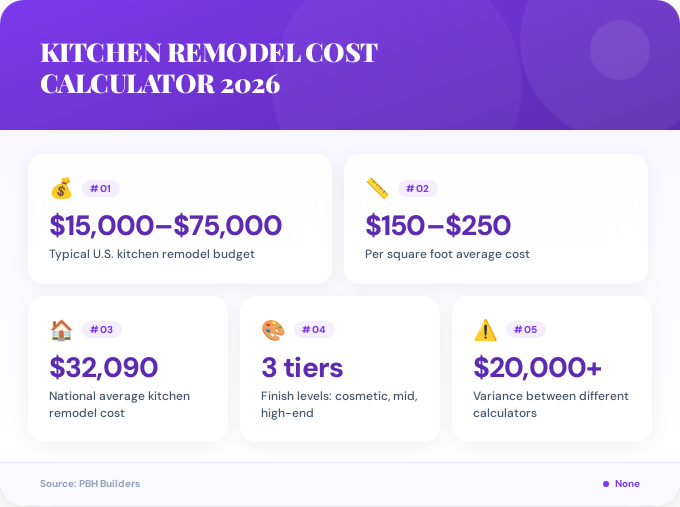
Most 2026 calculators converge on a similar planning window: a realistic U.S. kitchen remodel budget runs $15,000 to $75,000 for the majority of projects, with major custom renovations exceeding $100,000. But published estimates vary widely depending on methodology. One tool from MyHomeQuote’s kitchen cost calculator places an average kitchen between $17,000 and $33,000, while Homewyse’s average kitchen remodel cost data reports a $32,090 national average. A separate 2026 cost guide puts a medium kitchen’s mid-range remodel at $35,000 to $70,000. None of these numbers is wrong; they’re simply measuring different scopes.
How Does the Math Behind These Calculators Work?
Nearly every calculator, regardless of brand, runs the same basic formula underneath the interface:
“Total project cost equals materials, plus labor, plus design and permits, plus appliances, plus contingency. The square-footage number you see first is just a shortcut for that whole equation, not a replacement for it,” notes the planning methodology used across most 2026 kitchen remodel calculators.
For an initial estimate, most tools apply $150 to $250 per square foot for an average-sized kitchen, then adjust up or down based on scope, location, and finish quality. This per-square-foot shortcut works reasonably well for mid-size kitchens but becomes unreliable at the extremes, which is why serious budgeting always requires a second pass with real line items. For a deeper walkthrough of this formula, see our companion piece on how a kitchen remodel cost calculator actually works.
| Project Type | 2026 Planning Range | What It Usually Includes |
|---|---|---|
| Cosmetic refresh | $15,000–$35,000 | Paint, hardware, backsplash, countertops, select appliances; existing cabinets and layout retained |
| Basic small remodel | $15,000–$30,000 | Stock cabinets or refacing, affordable counters, limited electrical/plumbing work |
| Mid-range remodel | $35,000–$75,000 | Semi-custom cabinets, new counters, appliances, flooring, lighting, backsplash |
| Full gut renovation | $75,000–$125,000+ | Demolition, new layout, significant electrical/plumbing, cabinets, finishes, appliances |
| High-end/custom | $100,000–$175,000+ | Custom cabinetry, premium appliances, specialty materials, structural changes |
How Does Kitchen Size Change the Estimate?
Square-foot pricing is genuinely useful for early-stage planning, but it becomes less accurate at the smaller end because fixed costs like mobilization, permits, demolition, design fees, and appliance installation don’t shrink proportionally with kitchen size. A 90-square-foot galley kitchen still needs a permit, a dumpster, and a licensed electrician, the same overhead a 200-square-foot kitchen carries, just spread over far less square footage.
Mid-range remodel: $25,000–$50,000
Major/custom: $50,000–$90,000+
Mid-range remodel: $35,000–$70,000
Major/custom: $70,000–$125,000+
Mid-range remodel: $45,000–$90,000
Major/custom: $90,000–$175,000+
One 2026 guide specifically pegs a basic 70-to-150-square-foot kitchen remodel at $18,000 to $35,000, which lines up closely with the small-to-medium ranges above. If you’re trying to narrow down which bracket applies to your home, our step-by-step kitchen remodel planning guide walks through how to measure scope before you ever request a quote.
What Does a Real Line-Item Budget Look Like?
Calculators are most useful when you can see how the total breaks down into parts, because that’s where you’ll find room to adjust. A representative 2026 example from a detailed kitchen remodel cost breakdown totals $34,515, with an estimated range of $26,922 to $51,427 once contingency and local variation are factored in.
| Component | Example Cost |
|---|---|
| Cabinets | $9,500 |
| Countertops | $3,800 |
| Appliances | $4,655 |
| Flooring | $2,200 |
| Fixtures, finishes, permits | $2,400 |
| Contractor labor | $11,960 |
| Estimated total | $34,515 |
Notice that labor consumes roughly 35% of this example budget, cabinets about 28%, and appliances 14%. That labor share tends to run even higher in markets with elevated construction wages, which is relevant if you’re budgeting in a coastal California market rather than a national average. If countertop selection is driving most of your uncertainty, our kitchen countertop materials cost guide breaks down material-by-material pricing in far more detail than any calculator slider can.
Why Do Different Calculators Give Different Numbers?
If you’ve compared two or three calculators and gotten wildly different results, you’re not imagining it. According to SimplyWise’s kitchen remodel cost analysis, the spread exists because tools define “remodel” inconsistently: some include demolition and permits by default, others treat those as add-ons, and still others assume you’re keeping your existing layout versus reconfiguring plumbing and electrical.
Industry forecasting also plays a role. Kitchen & Bath Design’s remodeling industry forecast notes that overall remodeling spending is expected to stay relatively flat moving into 2027, which means the wide cost ranges calculators show today aren’t likely to shrink dramatically; pricing variation is structural, not just a temporary market quirk. Additional analysis from a 2026 kitchen renovation cost breakdown echoes this, showing that regional labor costs alone can shift a project’s total by 20% or more between markets.
How Should You Use a Calculator to Budget Accurately?
Treat every calculator output as a draft, not a quote. Here’s the sequence that produces the most reliable number:
- Start with square footage and finish tier to get a broad range, not a single figure.
- Break the total into the five core categories: materials, labor, design/permits, appliances, and contingency (plan for 10 to 20% contingency minimum).
- Adjust for your region. San Diego labor and permitting costs typically run above the national averages baked into most generic calculators.
- Decide on scope before pricing finishes. A full layout change with moved plumbing costs dramatically more than a cosmetic refresh, even in the same square footage.
- Get a contractor walkthrough once your calculator range feels realistic, since only an in-person assessment can price your specific cabinets, electrical panel capacity, and structural conditions.
If financing is part of your planning process, it helps to know your rough budget range before you talk to a lender. Our guide to kitchen remodel financing options and loans explains how different loan products line up with different project sizes, and our breakdown of how project timeline affects your final budget shows how delays themselves add real cost.
What Can’t a Calculator Tell You?
Calculators are built on averages, and your kitchen isn’t average. They can’t see your home’s electrical panel, whether your plumbing needs to be relocated, local permit fees, or whether your cabinets are custom-built versus stock. They also rarely account for specialty add-ons like a new island, which our guide on kitchen island addition costs and permitting requirements covers in depth, or backsplash tile work, detailed in our piece on what drives backsplash tile installation cost.
Sustainability choices also move the number in ways calculators often miss entirely; our eco-friendly kitchen remodeling cost guide shows how energy-efficient appliances and sustainable materials shift both upfront cost and long-term savings. For a general cost framework beyond kitchens specifically, resources like DecorAI’s kitchen remodel cost overview and TradePilot’s 2026 kitchen remodel cost analysis reinforce the same lesson: online tools estimate, local professionals price.
- Key Takeaways
- A realistic 2026 kitchen remodel budget spans $15,000 to $75,000 for most projects, with custom work exceeding $100,000.
- Calculators use a core formula: materials + labor + design/permits + appliances + contingency.
- Per-square-foot pricing ($150–$250/sq ft) is a useful starting shortcut but loses accuracy for very small or very large kitchens.
- Labor typically represents 30 to 35% of a total project budget in most line-item examples.
- Different calculators produce different numbers because they define “remodel” scope inconsistently.
- Always build in 10 to 20% contingency and treat calculator output as a planning range, not a fixed quote.
- A final, accurate number requires an in-person walkthrough with a licensed contractor who knows your local market.
People Also Ask
How accurate are online kitchen remodel cost calculators?
Online calculators are reasonably accurate for broad planning ranges but rarely match final contractor quotes exactly, since they can’t see your home’s specific electrical, plumbing, or structural conditions. Use them to set an expected range, then confirm with an in-person estimate.
What is the average cost of a kitchen remodel in 2026?
Most sources place a typical kitchen remodel between $15,000 and $75,000, though published averages range from roughly $17,000 to $33,000 on one calculator and over $32,000 on another, depending on scope definition. Pricing varies based on your specific project, location, and finish quality.
How much does a kitchen remodel cost per square foot?
Most 2026 calculators use $150 to $250 per square foot as a starting baseline for an average-sized kitchen, then adjust for finish level and region. This shortcut becomes less reliable for very small kitchens, where fixed costs like permits and demolition don’t shrink proportionally.
What percentage of a kitchen remodel budget goes to labor?
In a representative 2026 line-item example, labor accounted for about 35% of the total budget, with cabinets around 28% and appliances near 14%. Labor’s share tends to run higher in regions with elevated construction wages.
Frequently Asked Questions
Why do kitchen remodel calculators give such different totals for the same size kitchen?+
Calculators differ because each tool defines “remodel” differently, some include permits and demolition by default while others don’t, and regional labor cost assumptions vary significantly. The underlying formula is similar, but the inputs and defaults behind each tool are not standardized.
Should I trust a calculator estimate over a contractor quote?+
No. A calculator is a planning tool to help you set expectations before you start requesting quotes; a contractor quote reflects your home’s actual conditions, local permitting requirements, and material selections. Use the calculator first, then validate with a professional walkthrough.
How much contingency should I add to my kitchen remodel budget?+
Most planning models recommend a 10 to 20% contingency on top of your estimated total, especially for older homes where hidden electrical or plumbing issues are common. This buffer protects your project from mid-renovation budget shocks.
Does a cosmetic refresh cost significantly less than a full remodel?+
Yes, a cosmetic refresh, which keeps your existing cabinets and layout while updating paint, hardware, countertops, and backsplash, typically runs $15,000 to $35,000, compared to $35,000 to $75,000 or more for a mid-range remodel involving new cabinetry and layout changes.
What inputs matter most for an accurate kitchen remodel estimate?+
Square footage, finish tier, and whether the layout or plumbing/electrical will be reconfigured are the three biggest drivers of cost. Regional labor rates and material selections, particularly cabinets and countertops, also significantly influence the final number.
Is kitchen remodeling expected to get more or less expensive after 2026?+
Industry forecasts suggest overall remodeling spending will stay relatively flat into 2027, meaning the wide cost ranges seen today are likely to persist rather than shrink. Material and labor costs remain the primary variables shaping any individual project’s final price.
Every calculator gives you a starting point, but your kitchen, your home’s systems, and San Diego’s local labor market are what actually determine the final number. If you want a budget range built around your specific layout rather than a national average, reach out to the PBH Builders team for a walkthrough, or explore our full range of remodeling services to see how we approach kitchen projects from first estimate to final walkthrough. You can also meet the people behind the work on our team page or learn more about our approach to remodeling before you request a quote.