Quick Answer
Kitchen remodel financing options and loans generally fall into five categories: cash savings, a home-equity loan, a HELOC, a cash-out refinance, or an unsecured personal/renovation loan. A fixed-rate home-equity loan suits a well-defined budget, a HELOC suits phased or uncertain costs, and both use your home as collateral, so comparing rates, fees, and repayment terms before signing is essential.
Why Does Financing Matter So Much for a Kitchen Remodel?
Most homeowners spend more time choosing a backsplash tile than comparing loan terms, yet the financing decision often has a bigger long-term financial impact than any material selection. A 4-basis-point gap between a home-equity loan and a HELOC can translate into thousands of dollars over a 10-year term, and choosing the wrong structure can leave a project half-finished if costs run over.
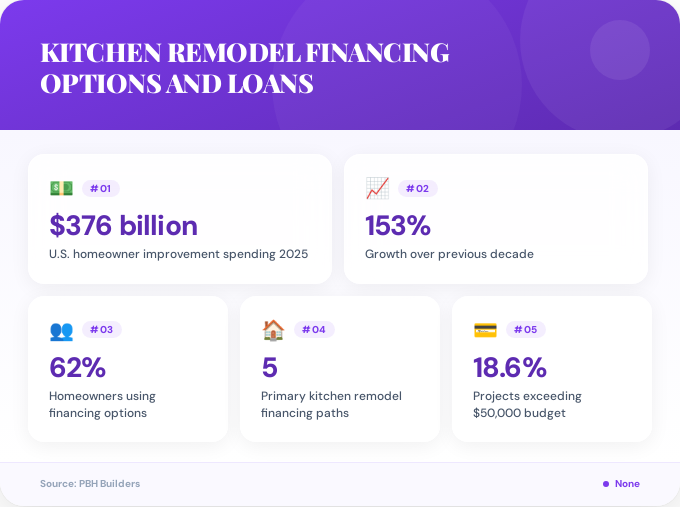
Kitchen remodel financing options and loans deserve the same scrutiny homeowners give to countertop materials or cabinet layouts, because the payment structure shapes what you can actually afford to build. U.S. homeowner improvement spending reached $376 billion in 2025, up 153% over the previous decade, and remodeling now represents 41% of total U.S. construction spending, compared with 34% in 2015. That growth did not happen with cash alone.
What Are the Main Kitchen Remodel Financing Options?
A 2026 homeowner survey found that 65% of respondents planned to remodel within 12 to 18 months, and among those homeowners, 62% expected to use financing other than cash. Nearly two-thirds expected to spend more than $10,000, and 18.6% expected to spend more than $50,000, which pushes many projects well beyond what a typical savings account can absorb comfortably.
The five primary paths are cash savings, a home-equity loan, a home-equity line of credit (HELOC), a cash-out refinance, and unsecured personal or renovation loans. Each has a distinct risk profile, qualification bar, and repayment structure, and the right fit depends heavily on whether your project has a fixed scope or an evolving one.
| Option | Best For | Main Drawback |
|---|---|---|
| Cash savings | Smaller projects, strong reserves | Reduces liquidity, may delay start |
| Home-equity loan | Defined scope, fixed contractor quote | Home secures the debt |
| HELOC | Phased work, change orders | Variable rate, payment can rise |
| Cash-out refinance | Large projects, rate-favorable timing | Replaces entire first mortgage |
| Personal loan | Limited equity, faster funding | Higher rate, shorter term |
How Does a Home-Equity Loan Work?
A home-equity loan gives you a lump sum upfront, secured by the equity in your home, with a fixed interest rate and a fixed monthly payment for the life of the loan. This structure works well when you already have a contractor’s quote in hand and a firm scope, such as a full gut-and-rebuild documented in a project outlined through our step-by-step kitchen remodel planning process.
Because the rate is fixed, your payment never changes even if broader interest rates move. The tradeoff is less flexibility: if your project ends up costing less than expected, you are still carrying the full loan amount, and if it costs more, you will need a second source of funds.
How Does a HELOC Differ From a Home-Equity Loan?
A HELOC works more like a credit card secured by your home: you are approved for a credit line and draw against it only as needed, typically making interest-only payments during the draw period. This is the better fit for phased remodels, projects with uncertain final costs, or homeowners who want to fund a kitchen renovation in stages alongside other work like flooring installation or exterior updates.
The flexibility comes with a catch: HELOC rates are usually variable, so your payment can climb if benchmark rates rise during your draw or repayment period. Recent data comparing the two shows just how close pricing has become between them.
When Does a Cash-Out Refinance Make Sense?
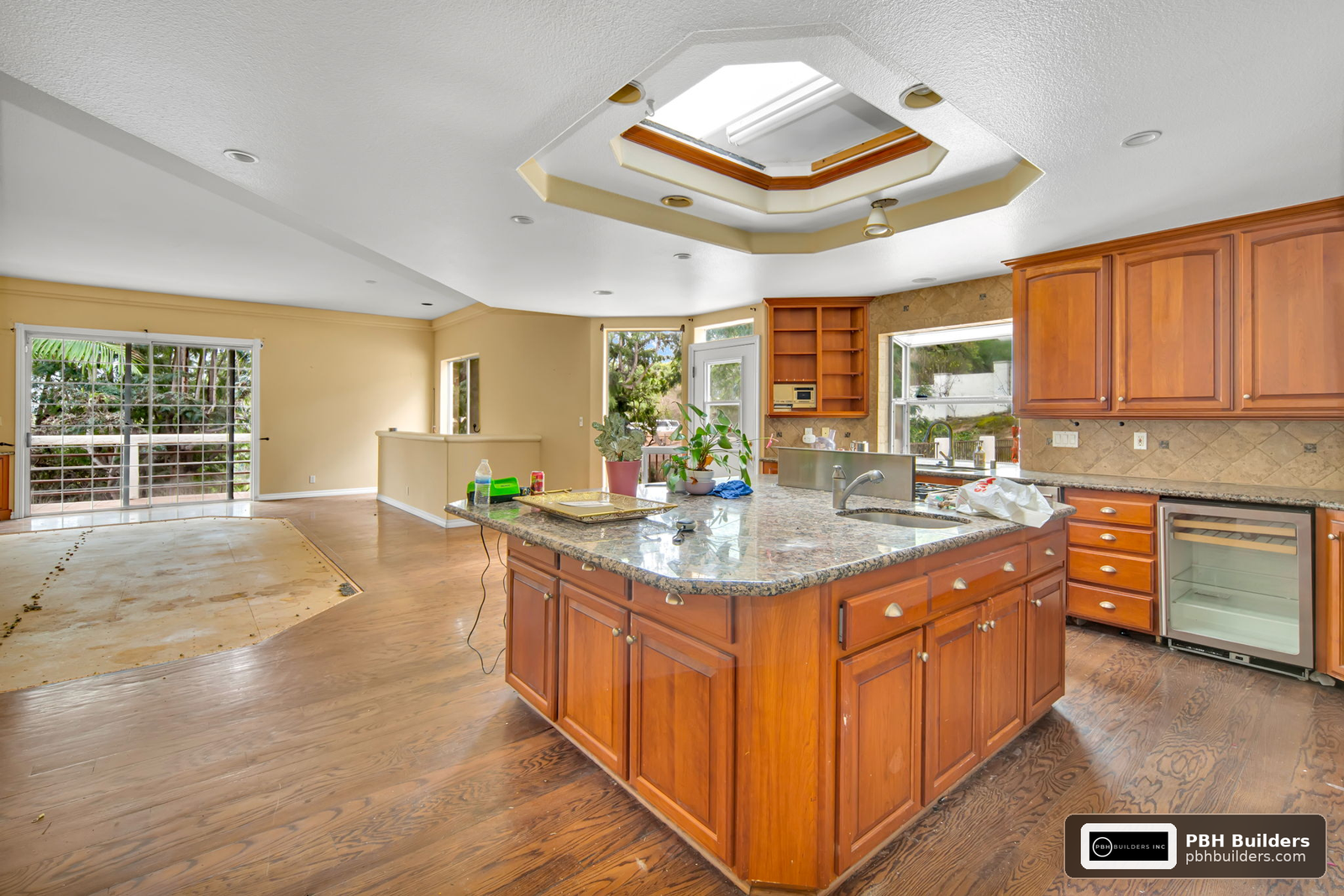
A cash-out refinance replaces your existing mortgage with a new, larger one, and you pocket the difference to fund the remodel. This approach consolidates your home purchase debt and your renovation debt into a single monthly payment, which can simplify budgeting for a large-scale project, such as adding a kitchen island alongside structural changes.
The downside is that you are restarting your mortgage clock and exposing your entire loan balance to whatever rate environment exists at closing, not just the renovation portion. If your current mortgage rate is well below market, a cash-out refinance can actually cost more overall than a separate home-equity product, even if the headline rate looks competitive.
What About Personal Loans and Government-Backed Programs?
Unsecured personal or renovation loans skip the home-as-collateral structure entirely, which appeals to homeowners without enough built-up equity or those who want to avoid a lien. Funding is often faster, but rates tend to run higher and terms shorter, so monthly payments on a large kitchen project can be steep; resources like comparison guides on home improvement loan lenders are useful for sizing up offers before committing.
For homeowners with limited income or specific property conditions, federally supported programs are worth investigating. The HUD Title I property improvement loan program insures loans made by approved lenders for home repairs and renovations, and state-level resources such as those listed through USA.gov’s home repair assistance directory or programs like state housing finance agency improvement loan programs can offer below-market terms for qualifying households.
How Should You Choose the Right Financing Option?
Start by pinning down your scope. A well-documented project, such as one following the planning framework in our guide to how remodel timelines affect your final budget, is much easier to finance with a fixed-rate product because the lender and the borrower both know the target number.
Why: Locked rate matches locked scope
Why: Draw only what you use
Why: Bundles renovation into one mortgage
Why: No lien, faster approval
Also weigh how the loan affects resale timing. If you plan to sell within a few years, review our analysis of kitchen remodel ROI and resale value before committing to a 15-year loan that may outlast your ownership of the home.
What Do Current Rates and Market Conditions Look Like?
As of late October 2026, reported national averages were approximately 8.27% for a 10-year home-equity loan, 8.28% for a 15-year loan, and 8.12% for a HELOC, based on an owner-occupied home, 80% loan-to-value, a $350,000 loan amount, and generally strong-credit assumptions. Another market dataset reported averages closer to 7.50% for fixed-rate home-equity loans and 7.54% for adjustable-rate HELOCs in early November 2026, underscoring how rates vary by lender, borrower profile, loan size, and calculation methodology, a pattern also explored in recent coverage comparing home-equity rate trends.
Broader remodeling demand has softened alongside this rate environment. Harvard’s Remodeling Futures Program expects annual improvement and repair spending to stay roughly flat near $525 billion through Q3 2027, with year-over-year growth reaching only 1.5% by that point, a trend echoed in the State of the Nation’s Housing 2026 report. In Q3 2026, the share of home-equity-investment inquiries tied to remodeling fell to 62.5%, down from 64.9% in Q2, a slowdown also detailed in HousingWire’s reporting on stalled remodeling interest, and broader frozen housing market dynamics covered by CNBC’s analysis of mixed signals facing remodelers.
Pricing for the remodel itself varies widely based on scope, materials, layout changes, and finish level, so it’s worth getting a custom quote rather than budgeting off a single average. A simple refresh with new countertops and a new backsplash costs far less than a full structural reconfiguration, and your financing choice should match that real number, not a generic estimate.
People Also Ask
Is it better to use a HELOC or a home-equity loan for a kitchen remodel?
A home-equity loan is better when you have a fixed scope and want a predictable payment, while a HELOC suits phased projects or uncertain costs where you want to draw funds as needed. Both use your home as collateral, so missed payments carry the same risk either way.
Can you get a personal loan for a kitchen remodel without home equity?
Yes, unsecured personal and renovation loans do not require home equity and typically fund faster than equity-based products. They usually carry higher interest rates and shorter repayment terms, so they work best for smaller projects or as a bridge until equity options become available.
Does a cash-out refinance make sense if my current mortgage rate is low?
Usually not. A cash-out refinance replaces your entire mortgage at the new market rate, so if your existing rate is well below current averages, a separate home-equity loan or HELOC typically preserves more value than refinancing the whole balance.
How much equity do I need to finance a kitchen remodel?
Most lenders cap combined loan-to-value around 80 to 85 percent of your home’s appraised value, meaning you generally need at least 15 to 20 percent equity remaining after the new loan. Exact requirements vary by lender, credit profile, and loan type.
Key Takeaways
- Kitchen remodel financing options and loans fall into five main categories: cash, home-equity loan, HELOC, cash-out refinance, and personal/renovation loans.
- Home-equity loans fit fixed-scope projects with known costs, while HELOCs fit phased work with evolving budgets.
- Late-2026 rate data shows home-equity loans and HELOCs trading within a few basis points of each other, often in the 7.5% to 8.3% range depending on the lender and loan structure.
- 62% of homeowners planning a remodel in 2026 expect to use financing other than cash, and 18.6% expect to spend more than $50,000.
- Government-backed programs like HUD Title I loans can offer alternatives for homeowners with limited equity or income constraints.
- Remodeling demand has softened into late 2026, which may create room to negotiate financing terms and contractor pricing.
- Pricing for the remodel itself should come from a project-specific quote, since scope, materials, and layout changes affect cost far more than any single average figure.
Frequently Asked Questions
What credit score do I need for kitchen remodel financing?+
Most home-equity loans and HELOCs require a credit score in the high 600s to low 700s for the best rates, though requirements vary by lender. Personal loans and government-backed programs sometimes offer more flexibility for borrowers with lower scores, often with a tradeoff in rate or loan amount.
Are kitchen remodel loan rates fixed or variable?+
Home-equity loans typically carry fixed rates for the life of the loan, while HELOCs are usually variable and can adjust with market benchmarks. Personal loans are most often fixed-rate, and cash-out refinances can be either depending on the mortgage product you choose.
How long does it take to get approved for home-equity financing?+
Home-equity loans and HELOCs typically take two to six weeks to close because they involve an appraisal, title review, and underwriting similar to a mortgage. Personal loans can fund in as little as one to five business days, which is why they’re sometimes used for urgent or smaller-scope repairs.
Can financing cover the full cost of a kitchen remodel including design and permits?+
Yes, most home-equity loans, HELOCs, and personal loans can be used for the entire project cost, including design fees, permits, materials, and labor. Lenders generally don’t restrict how renovation loan proceeds are spent, but it’s smart to build a contingency into your requested amount for change orders.
What happens if I can’t repay a home-equity loan or HELOC?+
Because these loans are secured by your home, defaulting can lead to foreclosure, similar to missing mortgage payments. This is why it’s critical to borrow only what you can comfortably repay and to build a realistic budget before committing to a secured financing product.
Should I finance a kitchen remodel or pay cash?+
Paying cash avoids interest and fees entirely, but it ties up liquidity that could otherwise serve as an emergency fund. Many homeowners choose a hybrid approach, paying part in cash and financing the remainder, particularly as federal guidance on property improvement loan insurance standards shows these products are structured to support exactly this kind of blended financing.
Choosing among kitchen remodel financing options and loans is ultimately about matching the loan structure to your project’s certainty level and your household’s risk tolerance. Before signing anything, get a detailed, written scope and quote so you borrow the right amount, not a guess. If you’re ready to turn a financing plan into an actual design, the team at PBH Builders can walk you through realistic project costs and connect you with the planning resources to move forward with confidence; visit our contact page to schedule a consultation.