Quick Answer
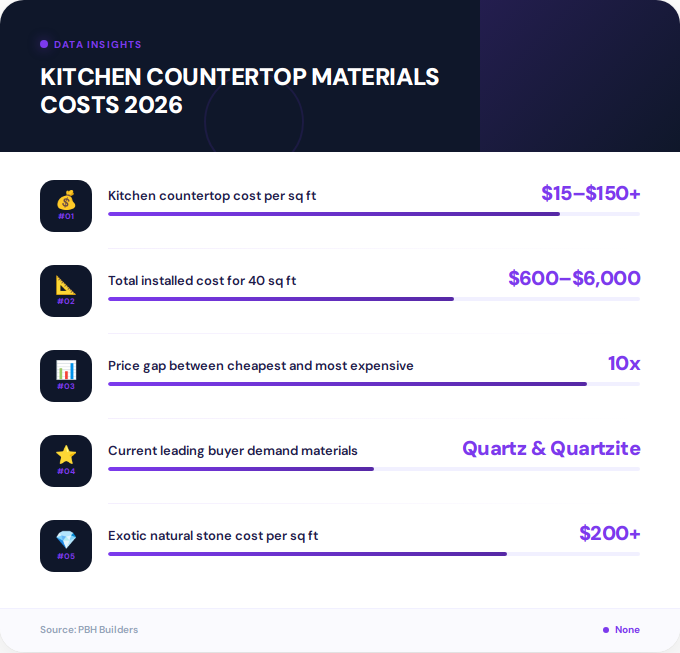
In 2026, kitchen countertop materials cost roughly $15 to $150+ per square foot installed, with exotic natural stone reaching $200 or more. For a typical 40-square-foot kitchen, total installed costs generally fall between $600 and $6,000 before demolition, plumbing, backsplash work, or structural repairs. Quartz and quartzite currently lead buyer demand, but the right choice depends on your budget, cooking habits, and how much maintenance you’re willing to do.
Here’s a number that surprises most homeowners: countertops can account for a larger share of a kitchen remodel’s total cost than cabinetry in many mid-range projects, and the gap between the cheapest and most expensive material options is often more than 10x per square foot. Understanding kitchen countertop materials costs 2026 isn’t just about picking a pretty slab. It’s about matching material science to your lifestyle, your budget, and how long you plan to stay in your home.
This guide breaks down what every major countertop material actually costs installed in 2026, why prices vary so widely between quotes, and which questions separate a fair deal from a costly mistake. Whether you’re planning a full kitchen overhaul or just replacing worn counters, this is the resource to read before you sign a contract.
Why Do Kitchen Countertop Prices Vary So Much in 2026?
U.S. kitchen countertop prices in 2026 generally range from about $15 to $150+ per square foot installed, with exotic natural stone reaching $200 or more. For a typical 40-square-foot kitchen, that translates to roughly $600 to $6,000 before demolition, plumbing, backsplash work, structural repairs, and unusual fabrication, according to data compiled by Fixr’s kitchen countertop installation cost breakdown.
That wide spread exists because “countertop cost” bundles several separate line items: raw material, slab size and rarity, fabrication complexity, edge profiles, sink cutouts, seams, templating, delivery, and installation labor. Two kitchens with the exact same square footage can land thousands of dollars apart depending on whether the layout needs waterfall edges, mitered corners, or an oversized island slab with no seams.
Published 2026 estimates also vary because some sources report material-only pricing while others include full installation, as noted in cost analyses from SimplyWise’s countertop installation cost review. Pricing varies based on your specific project, so any number you see online should be treated as a starting point, not a quote. If you’re mapping countertops into a broader renovation, our step-by-step kitchen remodel planning guide walks through how material decisions fit into the overall budget sequence.
What Does Each Countertop Material Cost Per Square Foot?
Below is a 2026 installed cost comparison across the most common countertop materials, based on current industry pricing data.
| Material | Cost per sq. ft. installed | Approx. 40 sq. ft. kitchen |
|---|---|---|
| Laminate | $15–$60 | $600–$2,400 |
| Tile | $15–$60 | $600–$2,400 |
| Butcher block / wood | $40–$100 | $1,600–$4,000 |
| Solid surface | $40–$100 | $1,600–$4,000 |
| Entry-level granite | $40–$60 | $1,600–$2,400 |
| Premium granite | $55–$110+ | $2,200–$4,400+ |
| Quartz | $50–$150 | $2,000–$6,000 |
| Porcelain slab | $60–$150 | $2,400–$6,000 |
| Soapstone | $60–$135 | $2,400–$5,400 |
| Quartzite | $60–$150+ | $2,400–$6,000+ |
| Marble | $60–$250+ | $2,400–$10,000+ |
| Exotic stone | Up to $200+ | $8,000+ |
Keep in mind these figures reflect material and fabrication categories; actual quotes from a licensed contractor will factor in your specific slab selection, cabinet layout, and local labor rates. For a full view of how countertops fit into overall renovation math, see our kitchen remodel cost breakdown by room size.
Quartz vs. Granite vs. Quartzite: Which Is Worth the Price?
These three materials dominate mid-to-premium kitchen remodels, and each has a distinct cost-to-performance profile. Quartz is engineered from crushed stone and resin, which makes it nonporous and low-maintenance, but premium patterns and designer brands can push pricing toward the top of the $50 to $150 per square foot range.
Granite remains a durable, heat-resistant natural stone, with entry-level slabs costing far less than exotic or rare-veined options that can approach $200 per square foot once fabrication and slab selection are factored in. Quartzite splits the difference: it offers a natural-stone look with quartz-like durability, but sealing is usually required, and pricing commonly lands between $60 and $150+ depending on the specific stone.
“Countertops have moved from a functional afterthought to the centerpiece of the kitchen experience. Homeowners are increasingly treating the slab selection process like choosing a piece of art, prioritizing veining and movement over simply matching cabinet color,” notes coverage from Fox 13’s feature on countertops becoming an experience.
A 2026 industry survey found quartz remains the top countertop choice, selected by 78% of respondents, with quartzite in second place, according to the Kitchen & Bath Design News 2026 countertop trends survey. That survey also found quartz and quartzite are the fastest-growing categories, signaling that buyers increasingly want natural-stone aesthetics without the upkeep granite and marble demand.
What Are the Best Budget-Friendly Countertop Options?
If budget is the primary constraint, laminate and tile remain the most economical choices, typically running $15 to $60 per square foot installed. Laminate has improved significantly in recent years, with high-definition printing that mimics stone and wood grain convincingly from a few feet away, though it remains less heat-, scratch-, and moisture-resistant than stone or quartz.
Butcher block and solid surface materials occupy the next tier, generally $40 to $100 per square foot. Solid surface is nonporous and repairable (scratches can often be sanded out), while butcher block offers warmth but requires periodic oiling and careful moisture management around sinks.
- Laminate: Best for rental properties, flip projects, or tight budgets prioritizing appearance over longevity.
- Tile: Affordable and individually repairable, but grout lines require ongoing maintenance.
- Butcher block: Warm, workable surface for bakers and cooks, but not ideal near wet zones.
- Solid surface: A seamless middle-ground option between laminate and stone.
- Entry-level granite: The most affordable true natural stone, often $40 to $60 per square foot.
Entry-level granite often delivers the best value-to-durability ratio for budget-conscious buyers who still want real stone. If you’re weighing countertops against other visible upgrades like tile work, our backsplash tile installation cost guide can help you sequence spending across both surfaces.
What Countertop Trends Are Shaping 2026 Budgets?
Demand is shifting noticeably toward quartzite and other natural stones as designers and homeowners seek distinctive veining after years of near-universal quartz adoption, a pattern documented in Houzz’s 2026 kitchen remodeling trends report. This shift matters for budgeting because natural stone slabs carry more price variability than engineered quartz, driven by rarity, slab size, and bookmatching.
Nearly half of industry respondents, 48.3%, said clients are willing to spend more on countertops than in previous years, while 46.3% said cost was only moderately important, slightly important, or unimportant in material selection, per the Kitchen & Bath Design News survey cited above. That signals a broader trend: homeowners are prioritizing long-term satisfaction and visual impact over squeezing out the lowest possible bid.
Porcelain slabs are also gaining traction for their heat-, stain-, and UV-resistance, though fabrication and edge work can require specialized tooling, as explained in the Daily Herald’s rundown on kitchen countertop options. If you’re incorporating sustainable material choices into your renovation, our eco-friendly kitchen remodeling cost guide covers recycled and low-impact countertop alternatives.
Maintenance: Low
Best for: Busy households
Maintenance: Moderate (sealing)
Best for: Natural-look seekers
Maintenance: Very low
Best for: Heat & UV exposure
What Questions Should You Ask Before Hiring a Fabricator?
The fabricator and installation team matter as much as the material itself. A poor seam placement or incorrect edge profile can undermine even the most expensive slab. Ask these questions before signing anything:
- Does the quote include templating, delivery, and installation, or just material? Many published price ranges only cover one piece of the total cost.
- How many seams will my layout require, and where will they be placed? Seam count and visibility affect both price and appearance.
- What is the lead time from template to install? This affects how your overall remodel timeline and budget come together.
- What warranty applies to the material and the fabrication? Stone suppliers and installers often carry separate warranties.
- Do you charge extra for sink cutouts, edge upgrades, or waterfall panels? These add-ons frequently surprise homeowners mid-project.
- Is the slab I’m viewing in the showroom the exact slab I’ll receive? Natural stone varies significantly piece to piece.
If you’re also adding an island as part of the project, our kitchen island addition cost and warranty guide covers how additional surface area and structural support change the countertop math.
What Red Flags Signal a Bad Countertop Quote?
Not every low bid is a good deal, and not every high bid guarantees quality. Watch for these warning signs during the quoting process.
- Vague per-square-foot pricing with no breakdown of material, fabrication, and installation labor.
- No in-person slab selection for natural stone, since photos rarely capture true veining and color.
- Unusually short installation windows that don’t allow for proper templating after cabinets are set.
- No mention of edge profile options or sink cutout costs upfront.
- Pressure to sign same-day without time to compare at least two or three quotes.
- No written warranty covering cracking, seam failure, or sealant performance.
Pricing varies based on your specific project, layout complexity, and material selection, so a detailed, itemized quote from an experienced contractor is the best protection against budget surprises. Industry data compiled by Stonify’s countertop cost overview reinforces that fabrication complexity, not just material choice, drives much of the final price variance between quotes.
Thinking beyond the countertop itself? A full renovation plan that sequences demolition, plumbing, cabinetry, and countertop installation correctly can prevent costly rework. Explore PBH Builders’ full remodeling services or learn more about our team’s approach to San Diego kitchen and bath projects.
Key Takeaways
- 2026 kitchen countertop costs typically range from $15 to $150+ per square foot installed, with exotic stone reaching $200 or more.
- A standard 40-square-foot kitchen generally runs $600 to $6,000 in countertop costs alone, before demolition or plumbing work.
- Quartz remains the top material choice at 78% of surveyed buyers, with quartzite the fastest-growing alternative.
- Nearly half of industry professionals report clients willing to spend more on countertops than in prior years.
- Entry-level granite offers the best value-to-durability ratio among natural stones.
- Always request an itemized quote covering templating, fabrication, edge work, and sink cutouts, not just material cost per square foot.
- Material choice should match lifestyle: heat and stain resistance matter more for active cooks than for light-use kitchens.
People Also Ask
What is the best material for kitchen countertops in 2026?
Quartz remains the top overall pick for most kitchens due to its low maintenance and durability, selected by 78% of surveyed buyers in 2026. Quartzite is the fastest-growing alternative for homeowners who want a more natural stone appearance with similar durability.
How much does a quartz countertop cost in 2026?
Quartz typically costs $50 to $150 per square foot installed in 2026, translating to roughly $2,000 to $6,000 for a 40-square-foot kitchen. Premium patterns and designer brands can push costs toward the higher end of that range.
Is granite or quartz cheaper?
Entry-level granite, at $40 to $60 per square foot, is generally cheaper than quartz, which starts around $50 per square foot. However, premium granite slabs can exceed quartz pricing significantly once rarity and fabrication complexity are factored in.
What countertop material requires the least maintenance?
Quartz and porcelain slabs require the least maintenance since both are nonporous and highly stain-resistant, needing no sealing. Natural stones like granite, marble, and quartzite typically require periodic sealing to maintain performance.
Frequently Asked Questions
What is the average cost to install countertops in a 40-square-foot kitchen?+
Costs typically range from $600 for budget laminate up to $6,000 or more for premium quartz, porcelain, or quartzite in a 40-square-foot kitchen. Exotic natural stone can push total costs above $8,000 depending on slab rarity and fabrication complexity.
Why do some countertop quotes seem so much higher than others?+
Published price ranges often differ because some include fabrication, templating, delivery, and installation while others only reflect material cost. Pricing varies based on your specific project scope, so it’s important to request an itemized quote for accurate comparison.
Is marble a good choice for kitchen countertops?+
Marble offers a premium, classic appearance but is vulnerable to etching and staining from acidic foods and liquids. It typically costs $60 to $250+ per square foot and suits homeowners prioritizing aesthetics who are willing to maintain it carefully.
How does countertop cost compare to other kitchen remodel expenses?+
Countertops are typically one of the largest line items in a kitchen remodel budget, often rivaling or exceeding cabinetry costs depending on material choice. Reviewing a full cost breakdown by room size can help you balance countertop spending against cabinets, flooring, and appliances.
Do I need to seal my countertops every year?+
Most natural stones like granite, marble, and quartzite need sealing roughly once a year, though some sealants last longer. Quartz and porcelain are nonporous and never require sealing, which is one reason they’ve become the leading choices in 2026.
Can I get an exact countertop quote online?+
Online price ranges are useful for budgeting but can’t account for your specific layout, slab selection, or local labor rates. A detailed, accurate quote requires an in-person or virtual consultation with a licensed contractor who can assess your kitchen’s unique requirements.