Quick Answer
A standard kitchen remodel is not tax-deductible, but specific energy-efficient upgrades installed during a kitchen remodel, such as Energy Star appliances, induction cooktops tied to electrical panel upgrades, or improved insulation, can qualify for federal tax credits under the Inflation Reduction Act through 2032. Most kitchen remodel costs instead count as a “capital improvement” that increases your home’s cost basis, which can reduce capital gains tax when you sell. Because every household’s tax situation differs, always confirm eligibility with a licensed tax professional before you file.
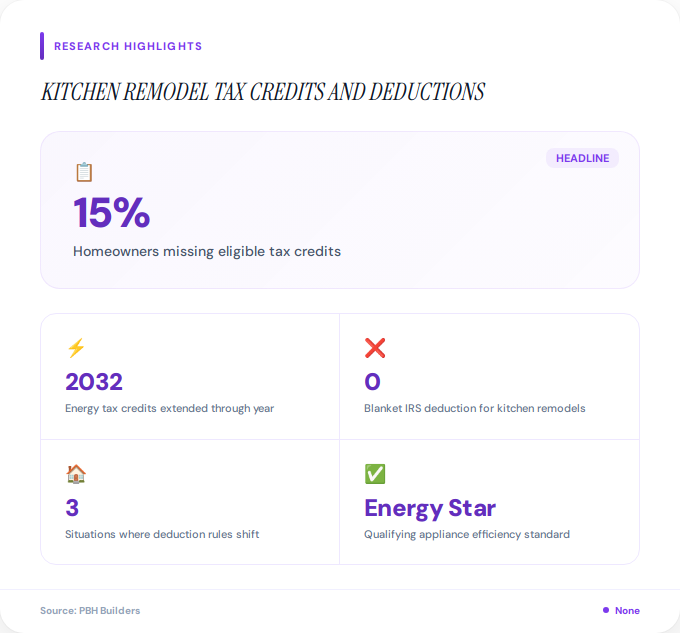
Here’s a number that surprises most people: the IRS has never offered a blanket tax deduction for kitchen remodels, yet roughly 15% of homeowners who complete a major renovation leave eligible energy-efficiency tax credits unclaimed simply because they didn’t know which products qualified. Kitchen remodel tax credits and deductions exist, but they’re narrower and more specific than most homeowners assume. If you’re planning a renovation and wondering what you can actually write off, the answer depends heavily on what you install, not just how much you spend.
This guide breaks down exactly which parts of a kitchen remodel might qualify for a federal tax credit, which ones simply add to your home’s cost basis for future capital gains savings, and which upgrades offer no tax benefit at all. We’ll also cover what typically drives the cost of a tax-smart kitchen remodel, since pricing varies based on your specific project scope, materials, and local labor conditions.
Why Do Homeowners Overlook Kitchen Remodel Tax Benefits?
Most homeowners assume a remodel is either fully deductible or not deductible at all, when the real answer lives in the gray area between the two. Kitchen renovations blend cosmetic upgrades like cabinetry and countertops with functional systems like electrical panels, water heaters, and appliances, and only the latter category typically intersects with federal tax incentives.
Confusion also comes from outdated information. Energy tax credit programs have changed significantly since the Inflation Reduction Act of 2022 expanded and extended incentives through 2032, replacing older, smaller credits that many homeowners still think are the current rules. If you haven’t reviewed the updated guidelines, you may be underestimating what’s available or missing a credit tied to a specific appliance or system upgrade.
Is a Kitchen Remodel Tax Deductible?
For most homeowners living in their primary residence, a standard kitchen remodel is not directly tax deductible in the year you complete it. The IRS classifies general remodeling, new cabinets, countertops, flooring, and layout changes as personal expenses or capital improvements, not deductible expenses like mortgage interest or property tax.
There are three situations where the rules shift:
- Home office use: If part of your home is used exclusively for business, a percentage of remodel costs tied to shared spaces may be deductible through the home office deduction.
- Rental or investment property: Kitchen remodels on a rental property can often be depreciated over time or partially expensed, since the IRS treats landlord expenses differently than personal residence costs.
- Medical necessity: If a kitchen modification is medically required, such as lowering counters for a wheelchair user, the portion of cost exceeding any added home value may qualify as a medical expense deduction.
Outside those scenarios, the deduction homeowners are really looking for usually comes from energy-efficient equipment credits, not the remodel itself.
What Energy-Efficient Upgrades Qualify for Tax Credits?
This is where kitchen remodel tax credits and deductions actually become valuable. The Energy Efficient Home Improvement Credit allows homeowners to claim a percentage of the cost of qualifying energy-efficient improvements, subject to annual caps, through 2032. Several items commonly installed during a kitchen remodel fall under this umbrella.
- Energy Star certified appliances like refrigerators and dishwashers generally don’t qualify directly under this federal credit, but some state and utility rebate programs do cover them, so it’s worth checking local programs alongside federal ones.
- Electric or induction cooktops paired with a qualifying heat pump water heater or panel upgrade can sometimes trigger credits tied to electrification projects.
- Panel upgrades and electrical service improvements installed to support new energy-efficient equipment may qualify for a separate credit, often capped at different levels annually.
- Insulation and air sealing added to exterior kitchen walls during a remodel can qualify under the building envelope portion of the credit.
- Energy-efficient windows and skylights replaced during a kitchen expansion or addition may qualify, subject to annual dollar caps.
If your remodel includes any electrification or insulation component, it’s worth discussing itemized invoicing with your contractor before work begins. Our kitchen remodel contractor hiring guide covers what to ask before signing a contract, including how to request documentation that supports tax filing later.
How Does a Kitchen Remodel Affect Your Home’s Cost Basis?
Even when a kitchen remodel doesn’t qualify for an immediate credit, it almost always helps you later. The IRS allows homeowners to add the cost of capital improvements, which includes most kitchen remodels, to their home’s “cost basis.” A higher cost basis reduces the taxable capital gain when you eventually sell the home.
Here’s why that matters: single filers can currently exclude up to a certain threshold of home sale profit from capital gains tax, and married couples filing jointly can exclude up to a higher threshold, as long as ownership and residency requirements are met. If your home’s value has appreciated significantly, especially in a market like San Diego, tracking capital improvement costs could keep you under that exclusion threshold and avoid an unexpected tax bill.
Qualifying capital improvements generally include:
- New cabinetry, countertops, and built-in features
- Structural changes like removing walls or adding square footage
- New plumbing, electrical, or HVAC systems installed during the remodel
- Permanent flooring upgrades
- Kitchen additions or expansions, similar to the structural work covered in our home additions services
Credit vs. Deduction vs. Cost Basis: What’s the Difference?
These three terms get used interchangeably, but they affect your taxes in very different ways. Understanding the distinction helps you know what to track and when the benefit actually arrives.
| Benefit Type | When You Get It | What Qualifies |
|---|---|---|
| Tax Credit | In the tax year the equipment is installed | Specific energy-efficient equipment, electrification, insulation |
| Tax Deduction | In the tax year of qualifying expense (rare for kitchens) | Home office portion, rental property expenses, medical necessity |
| Cost Basis Increase | When you sell the home | Nearly all capital improvements, including most kitchen remodels |
What Moves the Price of a Tax-Smart Kitchen Remodel?
If you’re planning a remodel partly to capture energy tax credits, it helps to understand what actually drives project cost. A simple cosmetic refresh costs significantly less than a full gut remodel involving new wiring, insulation, and appliance circuits, and the latter is usually what unlocks credit-eligible upgrades. Call for a free written quote to understand your project’s specific cost factors.
- Scope of electrical work: Upgrading your panel to support induction cooktops or heat pump equipment adds labor and permitting costs but is often what makes a credit possible.
- Appliance tier: Energy Star certified appliances and induction ranges typically carry a higher upfront price than standard models, though they may qualify for state or utility rebates.
- Structural changes: Removing walls, expanding square footage, or relocating plumbing adds significant cost and also adds meaningfully to your cost basis.
- Insulation and envelope work: Adding insulation behind new cabinetry or around exterior walls increases labor time but can qualify for the building envelope portion of federal credits.
- Permits and inspections: Electrical and structural work generally requires permitting, which affects timeline and cost but also creates the paper trail you’ll need for tax documentation.
- Finish level and materials: Custom cabinetry, natural stone countertops, and designer fixtures sit at a different price point than stock materials, independent of any tax consideration.
Because every kitchen and every home’s electrical and structural condition is different, the only reliable way to understand your numbers is a project-specific, written quote. For a deeper look at how contractors estimate these variables, see our guide on how kitchen remodel cost calculators actually work.
What Records Do You Need to Claim These Benefits?
Good documentation is the difference between a smooth tax filing and a denied credit. Keep every invoice, receipt, and manufacturer certification statement tied to your remodel, ideally organized by category.
Needed: Itemized equipment invoice
Needed: Installation date and address
Needed: Permit records
Needed: Before/after photos (supporting evidence)
Needed: Lease documentation
Needed: Separate expense ledger
Hold onto these records for as long as you own the home, plus several years after you sell, since cost basis adjustments are often only needed at the point of sale. If you’re also considering how to pay for the project itself, our breakdown of kitchen remodel financing options and loans explains how different funding methods can interact with these same tax considerations.
Key Takeaways
- A standard kitchen remodel is not directly tax deductible for most primary residences, but specific energy-efficient equipment may qualify for federal tax credits through 2032.
- The Energy Efficient Home Improvement Credit can cover a percentage of costs for qualifying electrification, insulation, and panel upgrade projects, subject to annual caps.
- Nearly all kitchen remodel costs can be added to your home’s cost basis, reducing capital gains tax when you eventually sell.
- Rental property owners have more deduction and depreciation options than primary residence owners.
- Itemized invoices separating equipment, labor, and materials are essential for claiming any credit.
- State and utility rebate programs often supplement federal credits, especially for appliances that don’t qualify federally.
- Always confirm current eligibility with a licensed tax professional, since credit rules and caps can change year to year.
People Also Ask
Are home improvements tax deductible in the year you make them?
Generally no, unless they involve specific energy-efficient equipment, a home office, a rental property, or medically necessary modifications. Most home improvements instead increase your home’s cost basis and provide a tax benefit only when you sell.
What kind of projects qualify for home improvement tax credits?
Projects involving energy-efficient windows, insulation, heat pumps, electrical panel upgrades, and certain electrification equipment typically qualify under the Energy Efficient Home Improvement Credit. Standard cosmetic upgrades like cabinets and countertops generally do not qualify on their own.
Are your home renovations tax deductible if you sell your house later?
Renovations aren’t deductible at sale, but qualifying capital improvements increase your cost basis, which can lower your taxable capital gain. This is especially valuable in markets where home values have appreciated significantly.
Do Energy Star kitchen appliances qualify for a federal tax credit?
Most standard Energy Star kitchen appliances like refrigerators and dishwashers don’t qualify directly for the federal Energy Efficient Home Improvement Credit, but some state and utility rebate programs do cover them. Always check both federal and local programs before purchasing.
Frequently Asked Questions
Can I deduct a full kitchen remodel on my taxes?+
No, a full kitchen remodel on a primary residence is not deductible in the year it’s completed. It can, however, increase your home’s cost basis, which reduces capital gains tax when you sell.
Which kitchen upgrades actually qualify for a tax credit?+
Energy-efficient equipment such as electrical panel upgrades tied to electrification, qualifying insulation, and certain windows or skylights can qualify under the federal Energy Efficient Home Improvement Credit. Standard cabinetry, countertops, and flooring do not qualify on their own.
Is a kitchen remodel on a rental property treated differently for taxes?+
Yes, rental property owners can often depreciate remodel costs over several years or deduct certain repair-related expenses in the year they occur. This is significantly different from the rules for a primary residence, so separate recordkeeping is essential.
What documentation do I need to claim an energy tax credit for my kitchen?+
You’ll need an itemized invoice separating qualifying equipment from labor and non-qualifying materials, plus a manufacturer certification statement confirming the equipment meets efficiency standards. Keep these records with your permit documentation in case of an audit.
Does adding square footage to my kitchen affect my taxes?+
Expanding your kitchen through an addition adds significantly to your home’s cost basis, which can reduce capital gains tax at sale. It may also trigger property tax reassessment, so it’s worth checking with your local assessor’s office before construction begins.
How much does a kitchen remodel typically cost when energy upgrades are included?+
Pricing varies widely based on scope, materials, electrical work required, and finish level. The best way to understand your project’s cost factors is to call for a free written quote based on your home’s layout and goals.
Should I talk to a tax professional before starting a kitchen remodel?+
Yes, consulting a licensed tax professional before construction begins is the best way to confirm which upgrades qualify for current credits and how to structure invoicing. This is especially important since federal and state programs can change from year to year.
Planning a kitchen remodel that balances design, function, and smart financial decisions takes the right team. Whether you’re exploring energy-efficient upgrades, a full layout change, or simply want to understand how home remodeling works from start to finish, PBH Builders has guided San Diego homeowners through every stage of the process. Explore our kitchen countertop materials and costs guide for more planning resources, or reach out for a custom, written quote tailored to your project and goals.