Quick Answer
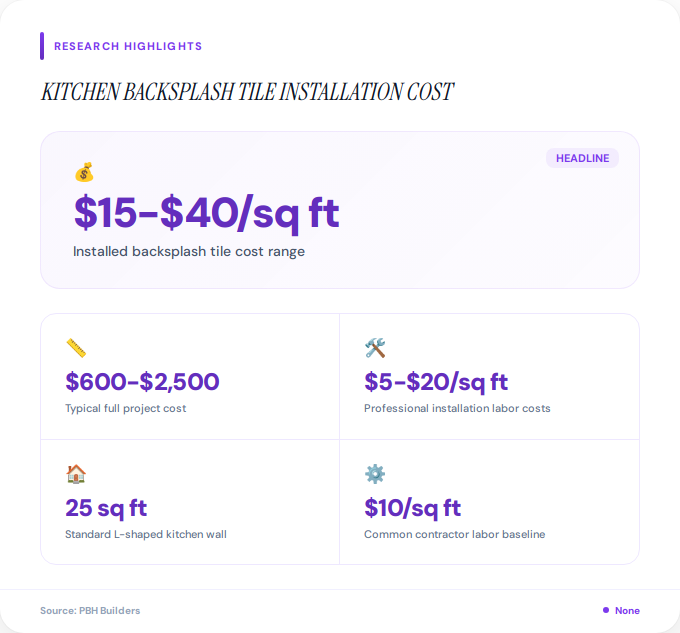
Kitchen backsplash tile installation typically runs $15 to $40 per square foot installed, with most full projects landing between $600 and $2,500 depending on tile material, wall condition, layout complexity, and local labor rates. Premium materials like natural stone, handmade mosaics, or slab-style backsplashes can push costs considerably higher, so pricing varies based on your specific project and is best confirmed with a custom quote.
What Is Actually Driving Your Backsplash Cost?
Here’s a number that surprises most homeowners: a backsplash covering roughly 25 square feet, about the size of a standard L-shaped kitchen wall run, can cost anywhere from $600 to $2,500 depending almost entirely on decisions made before a single tile is set. The tile itself is often the smallest line item. Kitchen backsplash tile installation cost is really a story about labor, wall prep, pattern complexity, and material grade stacking on top of one another.
Multiple current cost guides put a 25-square-foot project near $800 for basic ceramic work, while broader national averages for 2026 projects land closer to $1,500 once tile upgrades, pattern work, and minimum labor charges are factored in, according to HomeAdvisor’s tile backsplash installation cost data. The spread exists because backsplashes are small-footprint, high-visibility projects where every material and design choice is magnified.
If you’re planning a broader kitchen renovation, it helps to see backsplash costs in context. Our kitchen remodel cost breakdown by room size shows how backsplash work fits into total project budgets.
How Much Does Kitchen Backsplash Tile Installation Really Cost?
Most installed backsplash work falls between $15 and $40 per square foot, covering tile, mortar, grout, and labor. Professional installation labor alone typically runs $5 to $20 per square foot, with $10 per square foot acting as a common contractor baseline, per labor cost benchmarks for tile backsplash installation. Material costs for basic ceramic tile add another $12 to $32 per square foot before installation is factored in.
One 2026 national cost model places fully installed pricing even higher, between $32.95 and $56.21 per square foot, reflecting markets with elevated labor costs or more intricate tile work. These wide ranges aren’t inconsistency, they reflect genuinely different projects. A small apartment refresh and a custom stone slab backsplash in a luxury remodel are not the same job, even though both get called “a backsplash.”
| Project Type | Typical Installed Cost |
|---|---|
| 25 sq ft, basic ceramic, sound wall | $600 – $1,000 |
| 30 sq ft, mid-range porcelain | $900 – $1,800 |
| 40 sq ft, glass tile or pattern work | $1,200 – $2,400 |
| 40 sq ft, natural stone or slab-style | $3,200 – $6,000 |
These are planning ranges, not guaranteed quotes. Pricing varies based on your specific project, including kitchen layout, wall condition, and how far your home is from the installer’s base, so the only way to get a firm number is a walkthrough and custom estimate.
How Does Tile Material Change the Price?
Material selection is often the single biggest lever on your final invoice. Ceramic tile remains the most budget-friendly option and is relatively easy to cut, which keeps labor time down. Porcelain costs more to install because its density requires harder cutting blades and more careful handling, even though material pricing is sometimes similar to ceramic.
Glass tile tends to raise labor costs because it chips easily, telegraphs any wall imperfection, and requires a more deliberate layout process. Natural stone adds sealing requirements, specialized cutting, and often color-matched grout, all of which extend installation time. Handmade or encaustic tile can be the most expensive category overall, since irregular dimensions slow down every step of the set, as noted in trend coverage from Homes & Gardens’ 2027 backsplash trend report.
Large-format tile is an increasingly popular middle ground. Fewer grout lines mean easier cleaning and a more seamless look, but the tradeoff is that walls must be flatter and more carefully prepped, since large panels reveal every dip or bulge. Design coverage on the shift toward large-format tile in 2027 kitchens notes this trend is accelerating as homeowners move away from busy mosaic patterns. For a deeper look at how material choices affect overall style and budget, see our kitchen backsplash guide to materials, styles, and costs.
Labor difficulty: Low
Best for: Budget-conscious updates
Labor difficulty: Moderate
Best for: Durability-focused kitchens
Labor difficulty: High
Best for: Accent walls, statement looks
Labor difficulty: Very high
Best for: Luxury, seamless designs
Why Does Labor Cost So Much More Than the Tile Itself?
On many jobs, labor outpaces material cost, and layout is the main reason why. A straight running-bond pattern on a flat wall is fast work. A herringbone pattern, a mosaic accent, or a pattern that must align around a window or range hood demands significantly more layout time, measuring, and cutting.
Installers also factor in setup, protection of countertops and cabinets, waste cutting around outlets, and cleanup, costs that exist whether the backsplash is 15 square feet or 50. That’s why small backsplashes often carry disproportionately high per-square-foot pricing. According to guidance on estimating tile installation labor, contractors frequently apply minimum project charges to cover travel and setup regardless of square footage.
If you’re weighing a backsplash upgrade against other kitchen projects, our guide on how project length affects your final kitchen remodel budget explains how sequencing affects overall spend.
What Hidden Costs Should You Budget For?
Several add-on costs catch homeowners off guard. Removing an old backsplash typically runs $3 to $6 per square foot, including disposal, and wall preparation or repair after removal can add another $150 to $600 to the overall project, according to cost breakdowns from renovation cost data for kitchen backsplash projects.
- Uneven or damaged drywall: may require patching or skim-coating before tile can be set.
- Electrical outlet relocation: common when upgrading to a taller or full-wall backsplash design.
- Waterproofing behind the range: sometimes required by code or recommended near heat sources.
- Specialty trim and edging: metal or bullnose trim pieces add material and labor cost.
- Grout sealing: particularly important for natural stone, which is porous and stain-prone.
Slab-style backsplashes, which extend a countertop material up the wall for a seamless look, run roughly $80 to $150 per square foot installed, according to pricing guidance on slab backsplash and countertop pairing. This is a premium category, but it eliminates grout lines entirely and pairs naturally with waterfall-edge islands. If an island is part of your renovation plans, see our kitchen island addition cost and benefits guide for related budgeting.
How Can You Control Costs Without Cutting Corners?
The smartest savings come from decisions made before installation day, not from choosing the cheapest tile available. Standardizing on a single tile size with minimal cuts reduces labor hours immediately. Choosing a mid-range ceramic or porcelain over hand-glazed or imported specialty tile can cut material cost substantially while still looking custom.
Confirming wall condition ahead of time avoids surprise prep charges once demolition begins. And bundling your backsplash with other kitchen work, like new countertops or flooring installation, can sometimes reduce per-project overhead since the crew is already on site.
Homeowners focused on long-term value should also weigh resale impact. Our analysis on kitchen remodel ROI and resale value breaks down which upgrades, including backsplash finishes, tend to recoup cost at sale. And if your project touches plumbing, electrical, or structural walls, review our guide to kitchen remodel permits and why they matter before work begins.
For homeowners prioritizing sustainability, recycled glass and reclaimed tile options are gaining traction, a trend covered in our eco-friendly sustainable kitchen remodeling cost guide, and echoed in design forecasting from designer predictions for 2027 backsplash trends.
- Installed backsplash pricing generally ranges from $15 to $40 per square foot, with full projects totaling $600 to $2,500 or more.
- Labor often costs more than tile, especially for intricate patterns, glass tile, or natural stone.
- Small backsplashes can carry higher per-square-foot rates due to minimum labor charges and setup time.
- Wall prep and old-backsplash removal can add several hundred dollars beyond the base tile and labor quote.
- Large-format tile and slab-style backsplashes are leading 2027 design trends but come at a premium price point.
- Getting a custom, on-site quote is the only reliable way to know your actual project cost, since layout and wall condition vary so much.
People Also Ask
Is $2,000 too much for a backsplash installation?
Not necessarily. $2,000 falls within the typical range for a mid-to-large backsplash using porcelain, glass, or a detailed pattern, especially once wall prep or electrical adjustments are included. It would be high for a small, basic ceramic project, so the right comparison depends on square footage and material.
How much does it cost to install a backsplash yourself versus hiring a pro?
DIY installation can cut labor costs, which often account for a large share of the total, but mistakes with cutting, leveling, or waterproofing can be costly to fix later. Many homeowners find that hiring a professional is worth the premium for visible, high-use areas like a kitchen wall.
What is the cheapest way to get a nice-looking backsplash?
Standard-size ceramic subway tile in a simple running-bond pattern is typically the most budget-friendly option that still looks polished. Avoiding mosaic sheets, specialty trims, and extensive wall prep also keeps costs down.
Does removing an old backsplash add significant cost?
Yes, removal typically adds $3 to $6 per square foot for demolition and disposal, and wall repair after removal can add another $150 to $600 depending on the condition underneath.
Frequently Asked Questions
What is the average cost per square foot for a kitchen backsplash?+
Most installed backsplashes cost between $15 and $40 per square foot, covering tile, mortar, grout, and labor. Premium materials like natural stone or slab-style treatments can push costs well beyond that range.
Why do small backsplashes sometimes cost more per square foot than large ones?+
Contractors apply minimum labor charges to cover travel, setup, cutting, and cleanup regardless of project size. A small job spreads those fixed costs over fewer square feet, raising the effective rate.
How much does labor alone cost for backsplash installation?+
Professional installation labor generally runs $5 to $20 per square foot, with $10 per square foot serving as a common baseline for standard ceramic or porcelain work. Complex patterns or specialty materials push labor costs toward the higher end.
Is porcelain or ceramic tile better for a kitchen backsplash?+
Porcelain is denser and more durable, making it a strong choice near cooking surfaces, though it costs slightly more to install due to harder cutting requirements. Ceramic remains the more economical and easier-to-install option for most kitchens.
How much more expensive is a slab-style backsplash than tile?+
Slab-style backsplashes typically run $80 to $150 per square foot installed, significantly more than standard tile, since the material is cut from the same stone or quartz slab as the countertop for a seamless appearance.
Does a full backsplash project include grout and sealing?+
Most full-project quotes include tile, mortar, grout, and basic labor, but sealing, especially for natural stone, is sometimes billed separately. Always confirm what’s included before comparing quotes from different contractors.
How do I get an accurate quote for my specific kitchen?+
Because wall condition, layout, and material choice vary so widely, the most accurate way to budget is an in-person assessment. Reaching out for a custom quote ensures pricing reflects your actual kitchen rather than a national average.
Backsplash tile is one of the few kitchen upgrades where the visual payoff and the budget impact are both immediate and highly visible. Whether you’re planning a simple ceramic refresh or a full slab-style transformation, getting the scope and material right from the start prevents costly mid-project changes. Explore our team’s approach to kitchen craftsmanship or visit PBH Builders to see how we scope backsplash and full kitchen projects across San Diego, then request a custom quote tailored to your space, timeline, and design goals.