
Quick Answer
A solid kitchen remodel warranty should include a written workmanship guarantee of at least 1 to 2 years, clear pass-through documentation for manufacturer warranties on cabinets, countertops, and appliances, and a defined process for reporting and resolving issues. Homeowners should negotiate these protections into the contract before signing, not after problems appear.
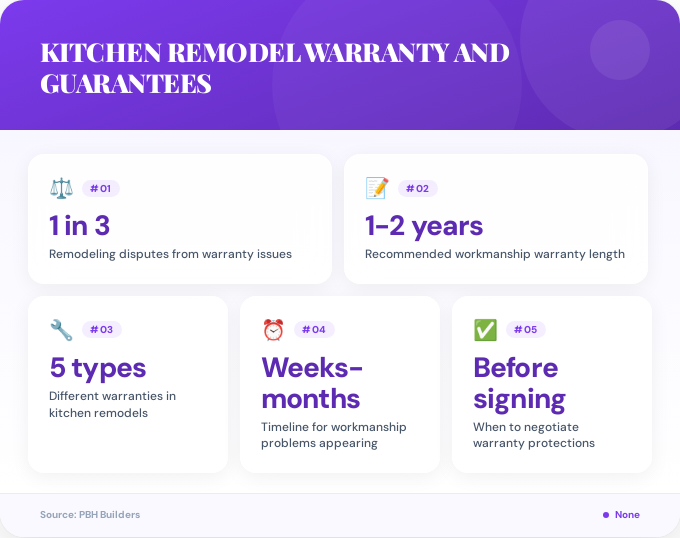
Nearly one in three remodeling disputes filed with state contractor licensing boards trace back to vague or missing warranty language, not shoddy work itself. A kitchen remodel warranty and guarantees package is the single most overlooked part of a renovation contract, yet it determines whether a cracked countertop seam or a misaligned cabinet door gets fixed for free or costs you another invoice six months after move-in.
This checklist walks through exactly what protections you should expect, what you can verify yourself as a homeowner, and where you genuinely need a contractor or legal professional involved. If you are still in the hiring phase, pair this with our kitchen remodel contractor hiring guide before you sign anything.
Why Does a Kitchen Remodel Warranty Matter More Than the Price Tag?
A kitchen remodel is one of the largest line items in a home improvement budget, and pricing varies based on your specific project, materials, layout changes, and finish level. But the lowest bid means little if there is no written guarantee behind the labor once the crew packs up and leaves.
Workmanship problems, like a leaking sink connection or an uneven tile grout line, often do not show up until weeks or months of daily use. Without a documented workmanship warranty, you are relying entirely on goodwill to get a contractor back on-site to fix something they already got paid for.
“Homeowners spend weeks picking cabinet finishes and countertop slabs, then sign a contract in five minutes without reading the warranty clause. That clause is what protects the investment after the dust settles,” says a project manager on the PBH Builders team.
What Types of Warranties Apply to a Kitchen Remodel?
A kitchen remodel is not covered by a single warranty. It is a stack of overlapping guarantees, each with its own scope, duration, and claims process.
- Workmanship warranty: Covers labor defects like poor caulking, misaligned installations, or faulty plumbing connections performed by the contractor’s crew.
- Manufacturer product warranties: Cover cabinets, countertops, appliances, faucets, and flooring against factory defects, typically issued directly by the manufacturer.
- Material and finish warranties: Cover things like quartz countertop staining, cabinet finish peeling, or tile cracking, often with separate terms from the installation itself.
- Structural or systems warranty: If the remodel touched electrical, plumbing, or load-bearing elements, these items may carry longer coverage under local code requirements.
- Implied warranty of habitability or workmanlike construction: A legal protection in many states that exists even without a written contract, though it is harder to enforce without documentation.

How Long Should a Kitchen Remodel Warranty Last?
Top industry benchmarks point to a 2-year limited workmanship warranty as the standard a reputable remodeling contractor should offer, with some premium builders extending coverage further on specific systems. Appliance and cabinet manufacturers typically layer their own terms on top, often ranging from 1 year to a lifetime depending on the product tier.
| Coverage Type | Typical Duration | Who Honors It |
|---|---|---|
| Labor / workmanship | 1 to 2 years minimum | Your contractor |
| Cabinets | 1 year to lifetime (varies by brand) | Manufacturer |
| Countertops | 10 years to lifetime | Manufacturer |
| Appliances | 1 to 5 years | Manufacturer |
| Plumbing/electrical systems | 1 to 2 years, longer in some states | Contractor and local code bond |
What Can Homeowners Check Themselves Before Signing?
Several warranty protections do not require a lawyer or licensed professional to verify. Walk through this list before you sign anything.
- Ask for the warranty in writing. A verbal promise that “we stand behind our work” is not enforceable. Request the exact clause and read it before signing.
- Confirm the warranty start date. Does coverage begin at final walkthrough, final payment, or the first day of work? This detail changes your real coverage window significantly.
- Collect manufacturer warranty cards and registration links for cabinets, countertops, and appliances as they are delivered, not after the project closes out.
- Check the contractor’s license and bond status through your state’s contractor licensing board website, which is public and free to search.
- Read the fine print on exclusions. Common exclusions include normal wear, homeowner misuse, or damage from unrelated plumbing issues.
- Save every receipt and product spec sheet in one folder (physical or digital) so you are not hunting for proof of purchase during a claim.
If you are also budgeting for the project, our guide on how a kitchen remodel cost calculator actually works can help you understand where warranty-backed materials fit into your overall numbers.

What Requires a Contractor or Legal Professional to Verify?
Some warranty protections are legally or technically complex enough that a homeowner should not navigate them alone.
- Reviewing contract warranty clauses for enforceability. A real estate or construction attorney can confirm the language actually protects you under your state’s laws, not just sounds protective.
- Verifying bonding and insurance coverage amounts are sufficient for the project scope. This often requires a direct call to the surety or insurance carrier, not just a certificate on file.
- Interpreting overlapping warranties when a failure could be either a workmanship issue or a product defect, such as a countertop that cracked near a sink cutout. A contractor needs to diagnose the actual cause before a claim can be filed correctly.
- Coordinating manufacturer warranty claims that require specific installer certification, which some high-end cabinet and countertop brands mandate.
- Addressing structural or code-related warranty disputes, which may require a licensed inspector’s report before any party will act.
This is where working with an established, licensed remodeling contractor matters. Learn more about how vetted professionals operate in our piece on how building contractors work.
What Warranty Red Flags Should Make You Walk Away?
Certain contract patterns are strong signals that warranty protections exist on paper only.
- A warranty clause shorter than 1 year with no explanation of what is excluded.
- Refusal to put the warranty terms in writing or “we’ll handle it if something comes up” verbal assurances.
- No mention of who handles manufacturer warranty registration or claims coordination.
- A contractor who cannot produce proof of current license and bond on request.
- Warranty language that requires you to waive your right to file a complaint with the state licensing board.
How Do You Negotiate Stronger Warranty Terms?
Warranty terms are negotiable, especially before a contract is signed. Ask directly for a minimum 2-year workmanship warranty in writing, a clear point of contact for claims, and a defined response time (many reputable contractors commit to inspecting a reported issue within 7 to 14 business days). Request that the contractor itemize which manufacturer warranties they will help register on your behalf versus which ones you must register yourself.
It also helps to ask how the contractor has handled past warranty claims. A contractor who can describe a real example, calmly and specifically, is usually more trustworthy than one who insists “that never happens.” For context on how remodeling projects typically unfold from contract to final walkthrough, see how home remodeling works.
Claims response: Undefined
Manufacturer pass-through: Homeowner’s responsibility
Claims response: 7 to 14 business days
Manufacturer pass-through: Contractor-assisted registration
Claims response: Named project manager
Manufacturer pass-through: Full documentation handoff at closeout
How Do You File a Warranty Claim After the Project Ends?
Document the issue with photos and a written description the moment you notice it. Contact your contractor’s listed warranty point of contact rather than the general office line, and reference your original contract and project date. If the issue is tied to a manufacturer product like an appliance or countertop material, your contractor should be able to tell you whether the claim routes through them or directly to the manufacturer.
Keep a written log of every call, email, and promised repair date. If a contractor becomes unresponsive, most states allow you to file a complaint with the contractor licensing board, which can prompt faster action than a phone call alone.
Key Takeaways
- A kitchen remodel warranty should include a minimum 1 to 2 year written workmanship guarantee, separate from manufacturer coverage.
- Collect and register manufacturer warranties for cabinets, countertops, and appliances as items are delivered, not at project end.
- Verify contractor license and bond status yourself through your state’s public licensing database before signing.
- Legal review of warranty clauses and bonding amounts is best left to a construction attorney or licensed professional.
- Negotiate a defined claims response window, ideally 7 to 14 business days, before work begins.
- Vague verbal promises are not enforceable; insist every guarantee is written into the contract.
- Keep organized documentation (photos, receipts, spec sheets) to speed up any future warranty claim.
People Also Ask
How long should a work warranty last?
A reputable remodeling contractor typically offers a workmanship warranty of at least 1 to 2 years, with 2 years being the stronger industry standard. Longer terms may apply to structural or systems work depending on local code requirements.
Does a remodeling contractor’s warranty cover incorrect installation?
Yes, a workmanship warranty is specifically designed to cover labor defects like incorrect installation, poor fit, or improper connections. It generally does not cover product defects, which fall under separate manufacturer warranties.
What is not covered by a kitchen remodel warranty?
Most warranties exclude normal wear and tear, damage from homeowner misuse, and issues caused by unrelated systems like preexisting plumbing problems. Always read the exclusions section before signing.
Can I negotiate warranty terms with a contractor?
Yes, warranty length, claims response time, and manufacturer registration responsibilities are all negotiable before you sign the contract. It is much harder to add these protections after work has started.
Frequently Asked Questions
What should be included in a kitchen remodel warranty?+
It should include a written workmanship guarantee of at least 1 to 2 years, documentation of manufacturer warranties for cabinets, countertops, and appliances, and a clear process for reporting issues and timelines for repair.
Who do I contact if my contractor won’t honor the warranty?+
Start with a written notice referencing your contract and warranty clause. If there is no response, you can file a complaint with your state’s contractor licensing board, which often prompts faster resolution.
Are appliance warranties separate from the contractor’s warranty?+
Yes, appliances carry their own manufacturer warranty, usually 1 to 5 years, that is separate from the contractor’s workmanship warranty covering installation. A good contractor will help you register these at delivery.
Does a kitchen remodel warranty affect resale value?+
A transferable workmanship warranty can be a selling point if you move before the coverage window ends. Check whether your contract allows the warranty to transfer to a new homeowner.
How much does a kitchen remodel warranty cost?+
A workmanship warranty is typically included in the overall project price rather than billed separately, and pricing varies based on your specific project scope and materials. Ask your contractor for a written, itemized quote so warranty coverage is clearly part of the agreement.
Can tax credits affect how I document my remodel warranty paperwork?+
Keeping thorough receipts and documentation for your warranty also supports any available tax credit or deduction claims tied to the project. See our guide on kitchen remodel tax credits and deductions for details on what records to retain.
A well-documented kitchen remodel warranty and guarantees package protects far more than countertops and cabinets, it protects your entire investment after the final walkthrough. If you are planning a project and want a contractor who puts warranty terms in writing from day one, reach out to PBH Builders for a custom quote or explore our full range of remodeling services to see how we build protection into every project from the start.