Quick Answer
A licensed building contractor in San Diego must hold an active California Contractors State License Board (CSLB) license, carry workers’ compensation and liability insurance, and pull permits through the city’s development services process before work begins. Understanding licensing, the typical four-phase project timeline, and common red flags helps homeowners avoid the delays, change-order surprises, and code violations that plague unvetted projects in San Diego’s high-permit-volume market.
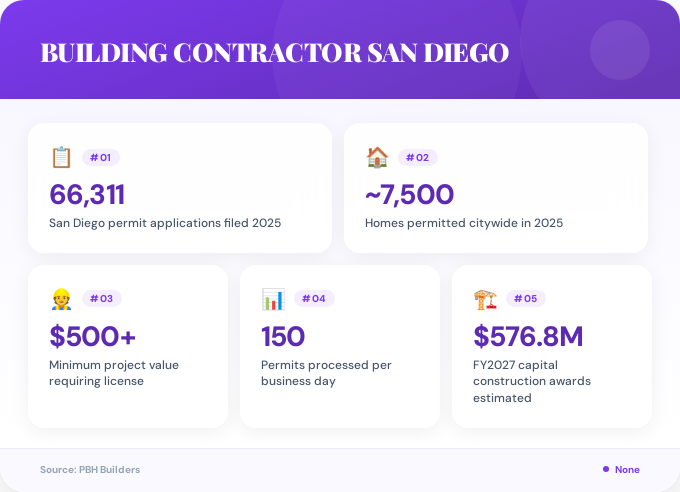
Roughly 66,311 permit applications moved through the City of San Diego’s development review system in 2025, and the city issued 54,674 permits that same year, according to its own reporting in the City of San Diego’s Construction Insider winter 2026 report. That volume means nearly 150 permits are processed every single business day, and it means the pool of people calling themselves a “building contractor San Diego” homeowners can trust has never been more crowded, or more uneven in quality.
If you’re planning a remodel, addition, or new build, understanding how licensing, permitting, and project phasing actually work puts you in a much stronger position than simply comparing bids. This guide walks through the regulatory mechanics behind every legitimate project in the region, so you know what to expect and what should make you pause.
What Does San Diego’s Building Contractor Market Look Like in 2026?
San Diego’s construction activity remains strong but uneven across sectors. The city reported approximately 7,500 homes permitted in 2025, above its long-term annual average, and updated community plans have added zoning capacity for roughly 105,000 additional homes citywide. That pipeline is real, but actual construction starts depend heavily on financing costs, labor availability, and site-specific feasibility.
Multifamily construction tells a more complicated story. San Diego had about 8,900 multifamily units under construction in the second quarter of 2026, yet multifamily permits issued in the first half of the year totaled only about 2,600 units, down 27% year over year, per NorthMarq’s Q2 2026 San Diego market insights report. Analysts forecast multifamily permitting to decline roughly 20% in 2026 compared with 2025, a signal that developers are pulling back even as existing projects finish out.
Single-family activity has been steadier. The San Diego metro area recorded about 1,200 privately owned housing units authorized by permit in September 2026 across all structure types, with single-family permits running near 303 seasonally adjusted units that month, up from 242 in August, based on Census Bureau data tracked through the Federal Reserve Economic Data building permits series for San Diego. On the public side, the city’s adopted FY2027 capital-improvement forecast includes roughly $576.8 million in estimated construction contract awards, with utilities and transportation projects accounting for the largest shares.
| Market Segment | 2026 Data Point |
|---|---|
| City permit applications (2025) | 66,311 filed, 54,674 issued |
| Homes permitted citywide (2025) | ~7,500, above long-term average |
| Multifamily units under construction (Q2 2026) | ~8,900 |
| Single-family permits (Sept. 2026) | ~303 seasonally adjusted units |
| FY2027 capital construction awards | $576.8 million estimated |
What License Does a Building Contractor Need in San Diego?
Every contractor performing work valued at $500 or more in labor and materials in California must hold an active license from the Contractors State License Board. For general building work, that’s typically a B-license (General Building Contractor), while specialty trades like electrical, plumbing, or roofing require their own C-class licenses. San Diego’s municipal code reinforces these state requirements through its own business licensing and permitting chapters, detailed in the City of San Diego municipal code governing contractor and permit administration.
A legitimate license is only part of the picture. You should also confirm the contractor carries current workers’ compensation coverage and general liability insurance, since an uninsured injury on your property can become your financial liability. Ask for the CSLB number directly and verify it yourself rather than taking a business card at face value; the CSLB’s public lookup tool shows license status, bond information, and any disciplinary history in seconds.
“The single most common mistake we see homeowners make is assuming a contractor is licensed just because they showed up with a truck and a crew. In a market issuing over 54,000 permits a year, verification takes two minutes and saves people from six-figure headaches,” notes a project manager familiar with San Diego’s permitting environment.
What Are the Typical Phases of a Building Project?
Whether you’re planning a kitchen remodel, a home addition, or a full ADU build, nearly every legitimate project follows the same structural sequence. Skipping or rushing any of these phases is usually where cost overruns and code violations originate.
- Design and scope development. This includes site assessment, architectural or design drawings, material selection, and a written scope of work. For guidance on how this works for kitchens specifically, see how to plan a kitchen remodel step by step.
- Permitting and plan check. Drawings go to the city’s Development Services Department for review against building, electrical, plumbing, and zoning codes.
- Contract and scheduling. A detailed written contract should specify scope, materials, payment schedule, and timeline before any deposit changes hands.
- Construction and inspections. Work proceeds in stages, with city inspectors signing off at key milestones like framing, rough electrical, and plumbing before drywall closes anything up.
- Final inspection and closeout. The city issues a final sign-off, and the contractor provides warranty documentation and lien releases.
Public data from the City of San Diego’s open development permits dataset lets homeowners track permit status, inspection history, and project records for any address in the city, which is a useful way to verify a contractor’s past work was actually permitted and closed out properly.
How Does Permitting Work in San Diego?
San Diego’s Development Services Department handles plan review, permit issuance, and inspections for nearly all residential and commercial construction. Minor work like like-for-like water heater replacement may qualify for over-the-counter permits, while additions, ADUs, and structural changes typically require full plan review that can take several weeks depending on current volume.
Given that the city processed roughly 140,000 inspections in 2025 alone, scheduling delays are a realistic part of any project timeline. A contractor experienced in San Diego’s specific process, including its ADU streamlining programs and density-bonus incentives, can often shave weeks off a schedule simply by submitting complete, code-compliant drawings the first time. The Associated General Contractors of San Diego, documented at AGC San Diego’s chapter resources, is one industry body that tracks local code updates and labor conditions affecting permit timelines.
What Red Flags Should Homeowners Watch For?
San Diego’s active permit environment unfortunately also attracts unlicensed operators hoping to blend in with legitimate volume. Here are the warning signs worth taking seriously.
- Reluctance to pull permits. A contractor suggesting you “skip the permit to save money” is asking you to accept all future liability for unpermitted work, which can complicate home sales and insurance claims.
- Large upfront deposits. California law caps down payments at 10% of the contract price or $1,000, whichever is less, for most residential projects.
- No fixed business address or local references. A rotating cast of unmarked vehicles and cash-only payment requests is a classic sign of an unlicensed operation.
- Vague written contracts. Missing start and completion dates, allowance amounts, or change-order procedures leaves too much room for disputes later.
- Pressure to sign immediately. Legitimate contractors expect you to compare bids and ask questions; urgency tactics are a pressure sale technique, not a professional norm.
It’s also worth noting that San Diego’s labor market has tightened in ways that affect pricing and availability. Local unemployment data tracked by the San Diego Union-Tribune’s September 2026 labor market coverage shows shifting conditions that can affect crew availability and project scheduling, which is one more reason to build schedule buffer into any contract.
How Much Should a Building Contractor Project Cost?
Pricing varies enormously based on scope, materials, site conditions, and the quality level you’re targeting, so treat any single “average price” with skepticism. A bathroom refresh might run $15,000 to $45,000+, a full kitchen remodel can range from $35,000 to $150,000+, and home additions commonly fall between $100,000 and $400,000+ depending on square footage and structural complexity.
Labor rates on public and prevailing-wage projects are published by the state and give a useful baseline for understanding skilled trade costs; the California Department of Industrial Relations prevailing wage determination for San Diego shows how trade-specific labor costs are formally set. For residential projects, your final number will depend heavily on finish selections. Our guides on kitchen countertop material costs and backsplash tile installation cost drivers break down how material choice swings a budget. If financing is part of your plan, it’s worth reviewing kitchen remodel financing options and loans before committing to a scope.
Drivers: fixtures, tile, layout changes
Drivers: cabinetry, countertops, layout
Drivers: foundation, square footage, permits
How Do You Choose the Right Contractor for Your Project?
Start by narrowing your list to contractors with an active CSLB license, verifiable insurance, and a portfolio of permitted work in San Diego specifically, since local code knowledge speeds up plan check and inspections. Ask for at least three references from projects similar in scope to yours, and if possible, drive by a completed job or an active site to see how the crew manages dust control, debris, and neighbor relations.
Review scope documents carefully for specificity. A detailed proposal should spell out materials, brand names, allowances, and a payment schedule tied to completed milestones rather than calendar dates. For a deeper look at how contractors structure bathroom projects specifically, our ultimate bathroom remodel contractor guide and San Diego bathroom remodeling guide walk through typical scope breakdowns. You can also review our team’s background and licensing on the PBH Builders about us page or meet the people who’ll actually be on your job site via our team page.
A written contract, a verified license number, and a realistic timeline tied to the city’s actual inspection volume will protect you more than any sales pitch ever will.
Key Takeaways
- San Diego issued 54,674 permits in 2025 out of 66,311 applications, reflecting an active but competitive construction environment.
- Every contractor working on jobs over $500 must hold an active CSLB license; always verify it independently rather than trusting a business card.
- California law caps contractor deposits at 10% of the contract or $1,000, whichever is less, so large upfront payment requests are a red flag.
- Multifamily permitting fell 27% year over year in the first half of 2026, while single-family permitting has trended upward month over month through September.
- Every legitimate project follows five phases: design, permitting, contracting, construction with inspections, and final closeout.
- Pricing for remodels and additions varies widely by scope and material quality; always request a custom quote rather than relying on generic averages.
- Public datasets like the city’s development permits tool let you verify a contractor’s permit and inspection history before signing anything.
People Also Ask
How do you find good contractors in San Diego?
Verify the CSLB license number directly, ask for recent local references, and confirm insurance coverage before requesting bids. Comparing at least three detailed written proposals, rather than just bottom-line prices, reveals the most about a contractor’s professionalism.
How long does it take to get a building permit in San Diego?
Simple over-the-counter permits can be issued same-day, while projects requiring full plan review often take several weeks depending on current submission volume. Given the city’s roughly 140,000 annual inspections, scheduling buffer is essential for any project involving structural or zoning changes.
What is the difference between a general contractor and a specialty contractor?
A general contractor (B-license) oversees multi-trade projects like remodels and additions, coordinating subcontractors and permits. A specialty contractor (C-license) is licensed for a single trade, such as electrical or plumbing, and typically works under a general contractor or directly for smaller single-trade jobs.
Is it worth building an ADU in San Diego right now?
San Diego’s updated community plans have added zoning capacity for roughly 105,000 additional homes, and ADUs remain one of the fastest-permitted housing types in the city. Feasibility still depends on lot size, financing, and your specific neighborhood’s zoning overlay, so a site-specific feasibility review is recommended.
Frequently Asked Questions
Do I legally need a licensed contractor for a San Diego remodel?+
Yes, for any project where labor and materials total $500 or more, California law requires a licensed contractor. Hiring an unlicensed worker for larger jobs voids many consumer protections and can jeopardize insurance coverage if something goes wrong.
What should be in a contractor’s written estimate?+
A complete estimate includes scope of work, specific materials and brands, a payment schedule tied to milestones, start and completion dates, and language on how change orders will be priced and approved. Vague or verbal-only estimates are a major warning sign.
How much can a contractor legally ask for as a deposit in California?+
California law limits down payments to 10% of the total contract price or $1,000, whichever is less, for most home improvement contracts. Requests above that threshold should be questioned immediately.
Why are San Diego permit timelines slower for some projects?+
With around 66,000 permit applications filed in a single year, review queues fluctuate based on project complexity and staffing. Complete, code-compliant drawings submitted by an experienced local contractor typically move through review faster than incomplete submissions.
Can I skip permits for small remodeling projects?+
Some minor cosmetic work like painting or flooring replacement doesn’t require a permit, but structural, electrical, or plumbing changes almost always do. Unpermitted work can create major problems when you sell your home or file an insurance claim.
How do I verify a contractor’s license is active?+
You can look up any California contractor’s license number directly on the CSLB website, which shows current status, bond information, insurance, and any disciplinary actions. This verification takes only a few minutes and should happen before signing any contract.
Planning a remodel or addition in the region? Explore PBH Builders’ San Diego project services or visit pbhbuilders.com to request a custom quote for your specific scope, timeline, and budget. You can also reach our team directly through the contact page to discuss permitting strategy before you commit to a design.