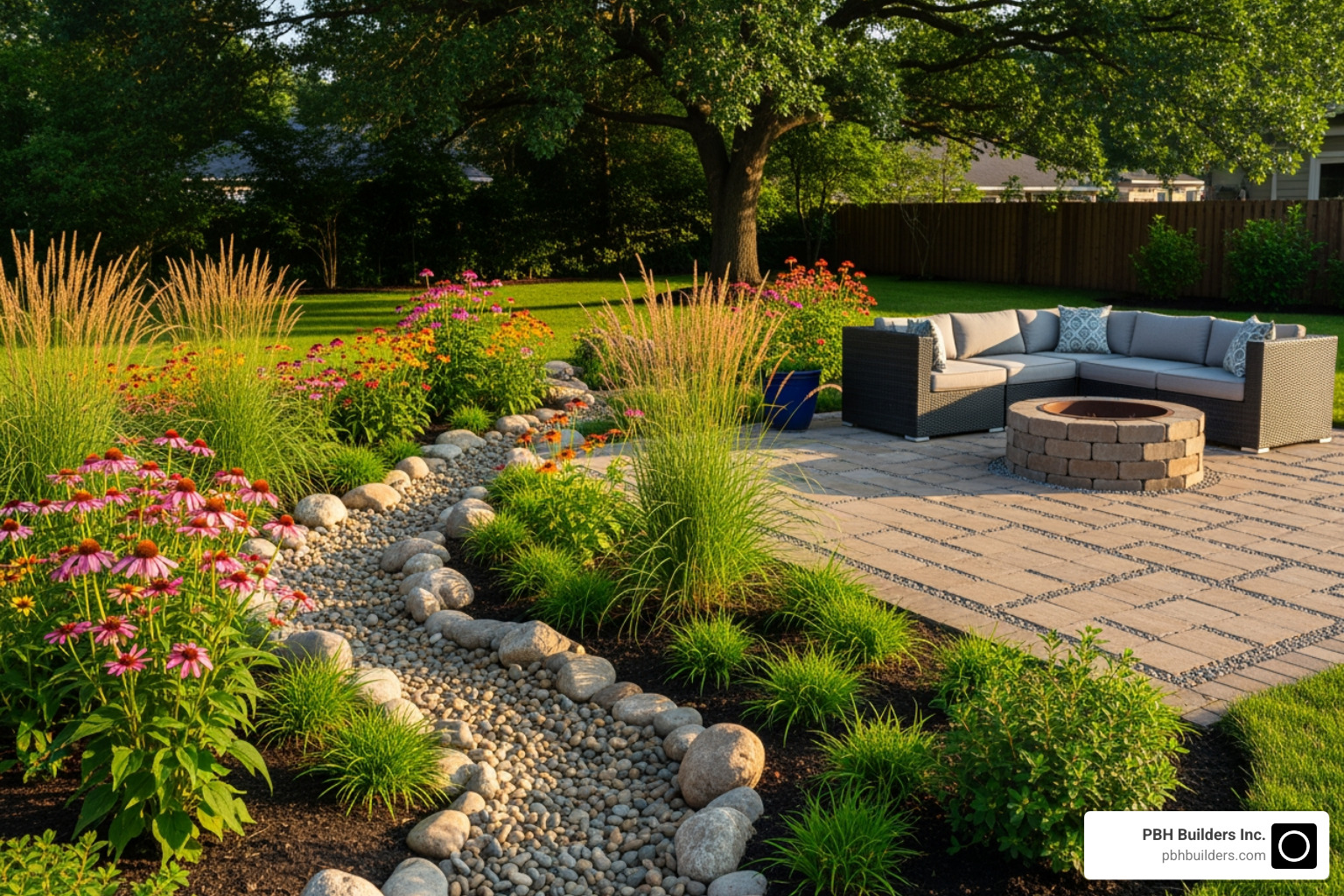
Why Proper Yard Drainage Matters for Your San Diego Home
Landscape drainage systems are essential for managing water flow on your property to prevent flooding, protect your foundation, and maintain a healthy yard. If you’re dealing with standing water, soggy lawns, or erosion, understanding your drainage options can save you thousands in repairs and transform your outdoor space.
Quick Overview of Common Landscape Drainage Solutions:
- French Drains: Underground pipes that redirect water.
- Trench/Channel Drains: Surface grates for driveways and patios.
- Swales: Shallow channels that slow and absorb runoff.
- Rain Gardens: Planted depressions that filter stormwater.
- Catch Basins: Collection points for downspouts and gutters.
- Dry Wells: Underground storage for slow soil percolation.
- Permeable Paving: Porous surfaces that let water pass through.
Hardscaping like patios and driveways often alters natural water flow, causing runoff and puddling. Fortunately, most drainage problems have straightforward solutions. Whether you’re fighting puddles, noticing foundation cracks, or tired of a muddy backyard, the right drainage system can fix it.
A few inches of rain on a typical suburban lot can produce 9,750 gallons of water runoff. Without proper management, that water can saturate soil around your foundation, kill landscaping, and create unusable muddy areas. In San Diego’s climate, with its periodic heavy rains and clay-heavy soil, managing this water is crucial to protecting your investment and outdoor lifestyle.
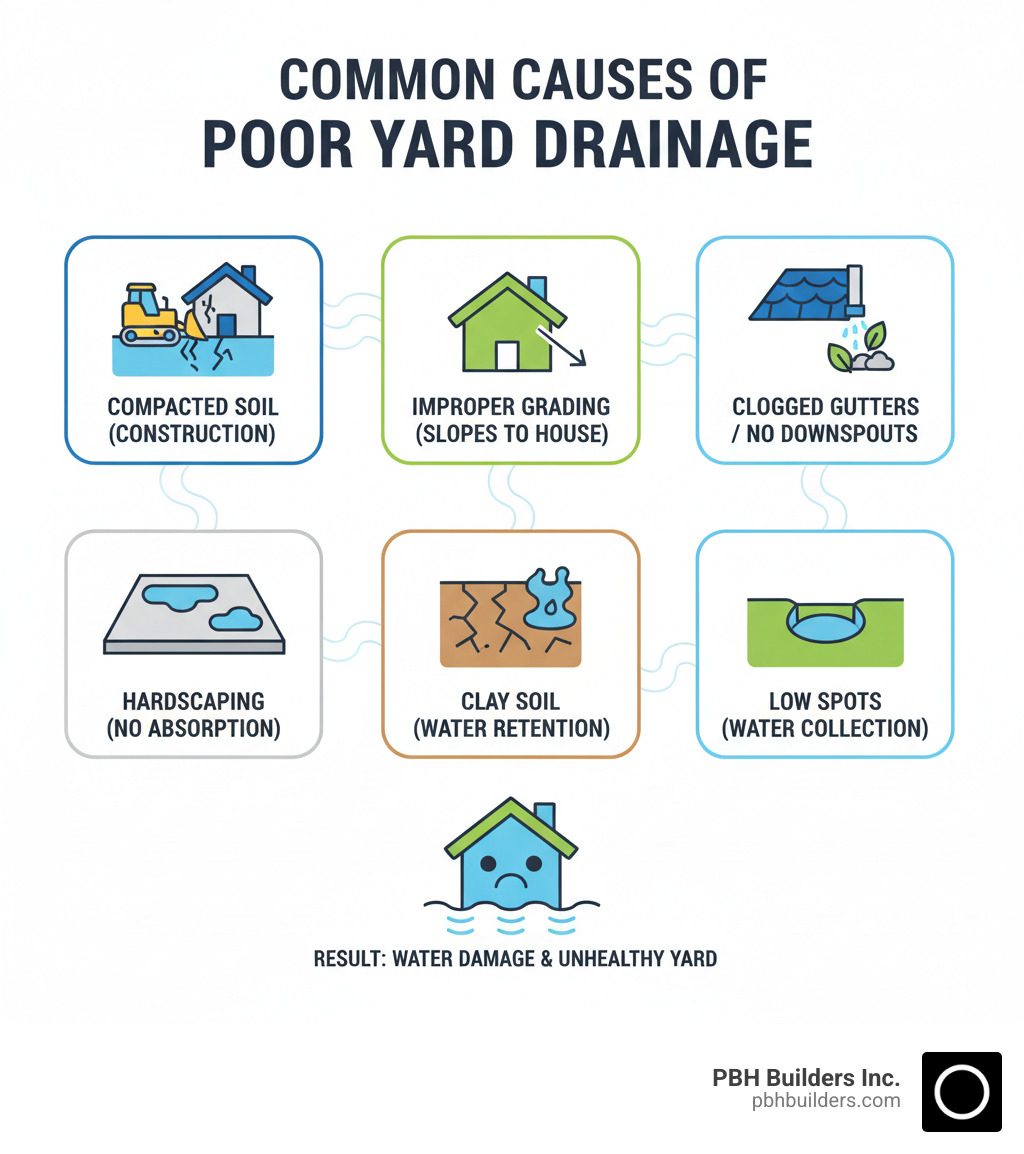
Landscape drainage systems further reading:
Is Your Yard Crying for Help? Signs of a Drainage Problem
Sometimes it’s hard to tell if you have a normal post-rain situation or a genuine drainage crisis. Learning to read your yard’s signals can save you thousands in foundation repairs and help you reclaim your outdoor space before small problems become disasters.
- Persistent water pooling for hours or days after rain is the most obvious red flag.
- A spongy or squishy lawn means the ground is completely saturated with nowhere for excess water to go.
- Bare patches where grass repeatedly dies suggest waterlogging is drowning the roots.
- An increase in mosquitoes or termites indicates that stagnant water is creating a welcoming environment for pests.
- Foundation cracks or basement dampness are serious structural threats that demand immediate action. When soil is saturated, it puts immense pressure on your foundation. For more insights, see why proper drainage is important.
- Soil erosion appears as ruts or gullies where fast-moving water has carved paths across your property.
- Overflowing gutters or downspouts that dump water next to your foundation are creating problems instead of solving them.

Why Proper Drainage is Crucial
Effective drainage is about protecting your property and creating usable outdoor spaces. It prevents plant death from root rot, provides critical foundation protection against cracks and structural damage, and makes your yard less hospitable to pests like termites. Proper landscape drainage systems transform unusable swampy zones into functional areas for recreation and entertainment while preventing soil erosion from washing away valuable topsoil. At PBH Builders Inc., we integrate proper drainage into every project. Learn more about our Landscape Design services.
The First Line of Defense: Gutters and Downspouts
Before investing in complex systems, ensure your gutters and downspouts are working correctly. This is the most cost-effective first step.
- Regular cleaning is essential. Clogged gutters overflow, dumping water next to your foundation. Clean them at least twice a year.
- Proper sizing matters. If your gutters are too small for your roof, they will overflow during heavy rain.
- Downspout extensions are inexpensive additions that move water at least 4-10 feet away from your house, preventing soil saturation around the foundation.
Directing water away from your foundation is the primary goal. Once your gutters are optimized, you can assess the need for more comprehensive drainage solutions. For guidance, see these tips for managing downspouts and gutters from the EPA.
Planning Your Solution: Key Factors to Consider
Before choosing a drainage solution, you must understand your property’s unique challenges. A proper assessment is key to a successful project. Observe your property during rain to see where water flows, pools, and if it runs toward your foundation. These observations are critical for planning effective landscape drainage systems.
Your yard’s topography plays a major role. Flat yards may pool water, while sloped yards can have erosion issues. Low spots are natural water magnets due to gravity.
Soil type is another crucial factor. Clay soil, common in San Diego, drains poorly and causes puddling. Sandy soil drains too quickly, sometimes causing erosion. Loam is a balanced mix that drains well while retaining moisture for plants.
Understanding your soil helps determine the right solution. A simple test can identify your soil type: dig a 12-inch deep hole, fill it with water, and time how long it takes to drain. If it drains in under an hour, you have sandy soil; if water is still there after four hours, you have clay. This information helps you work with your soil, not against it.
For a helpful visual guide on checking your yard’s slope, watch this video: [How to Properly Grade Around Your Home](https://www.youtube.com/watch?v=5hYIda7tWqA).
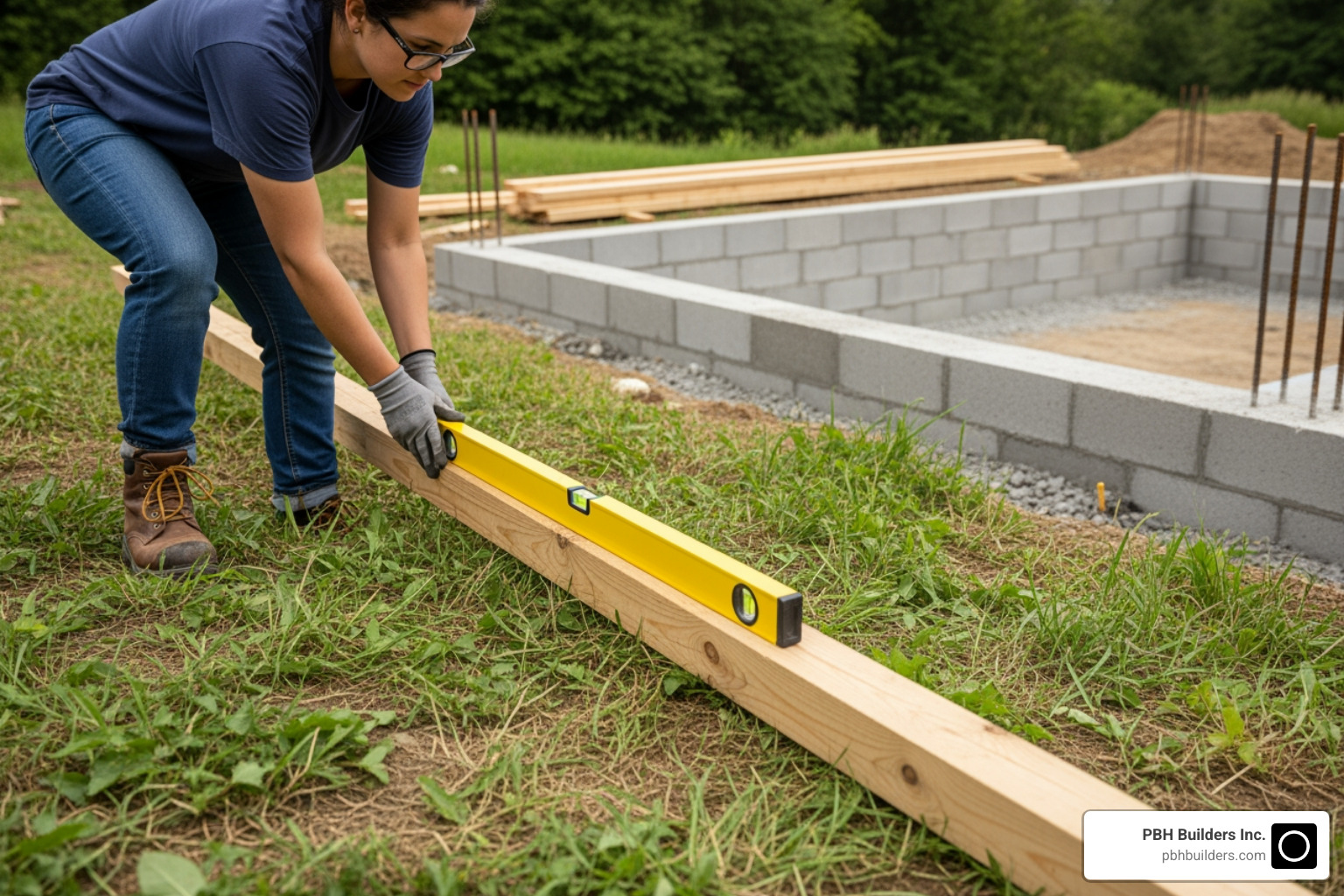
The Importance of Grading and Sloping
Proper grading—reshaping your yard to create the right slope—is a simple but powerful solution. The goal is to ensure water flows away from your house.
The ideal slope is a 1-inch drop per foot of horizontal distance, especially for the first 10 feet away from your foundation. This gentle grade is enough to keep water moving without causing erosion.
Creating a positive grade involves building up soil around your foundation and sloping it away. While this is easiest during initial construction, it can be addressed later. If you’re planning new hardscaping or a landscape redesign, it’s the perfect time to fix grading issues.
Proper grading is a maintenance-free solution that uses gravity to protect your home. We integrate correct grading into all our projects, ensuring our designs are both beautiful and functional. Learn more about our [Hardscaping Services](https://pbhbuilders.com/blog/hardscaping-services/).
A Guide to Common Landscape Drainage Systems
With a clear understanding of your yard’s needs, you can explore the toolkit of available landscape drainage systems. The best approach often combines several solutions custom to your property, budget, and aesthetic goals.
Here’s a quick comparison of the most common systems:
| Drainage System | Average Cost (Professional) | Maintenance | Best Use Cases |
|---|---|---|---|
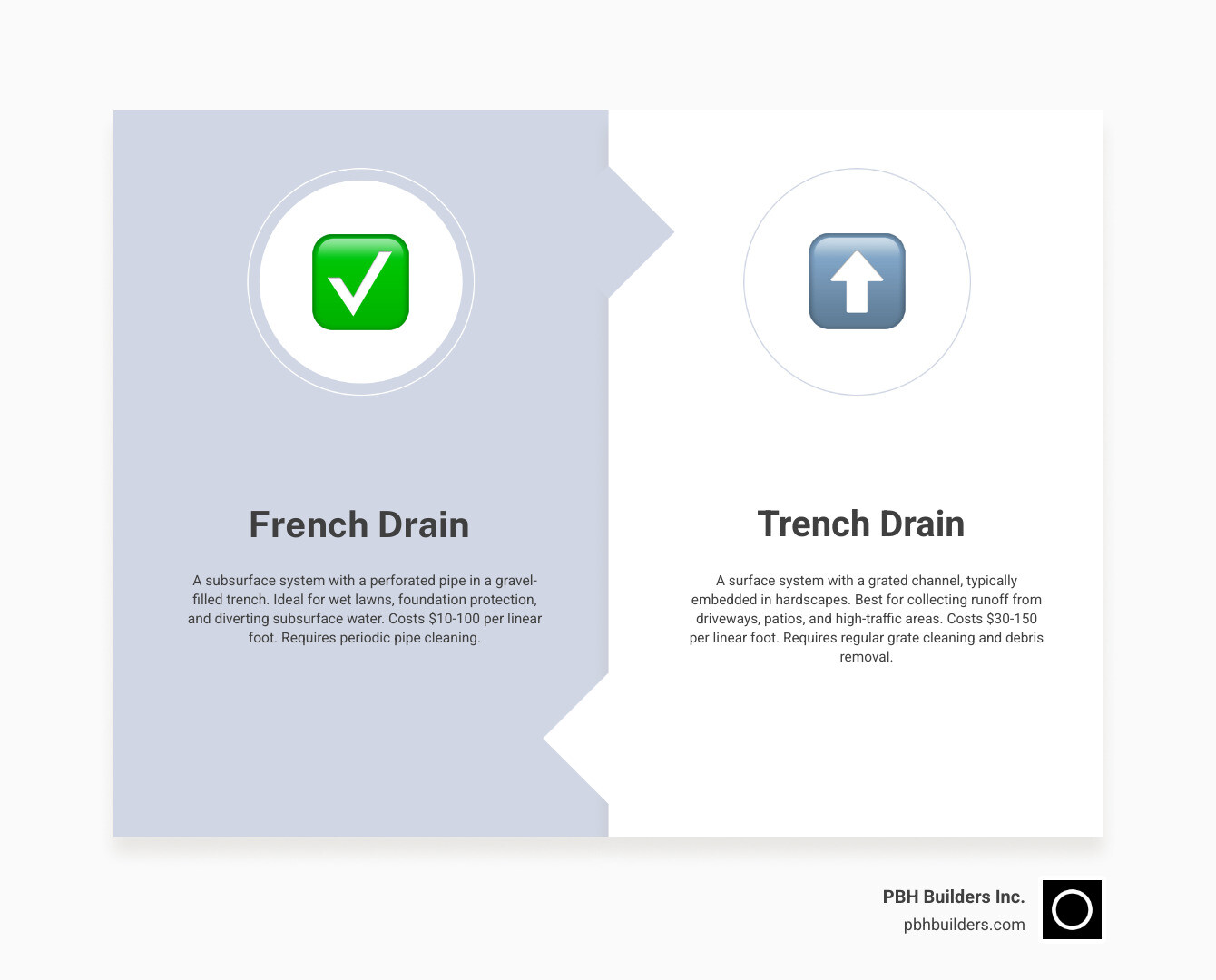
| French Drain | $10-$100 per linear foot | Periodic pipe cleaning, outlet check | Wet areas, foundation protection, subsurface water |
| Trench/Channel Drain | $30-$150 per linear foot | Regular grate cleaning, debris removal | Driveways, patios, hardscapes, high traffic areas |
| Swale | $5-$15 per linear foot | Mowing, weeding, sediment removal | Gently sloping areas, large landscapes, slowing runoff |
| Rain Garden | $4-$30 per square foot | Weeding, plant care, occasional sediment removal | Collecting runoff from impervious surfaces, eco-friendly, aesthetic |
Surface Drainage Solutions: Channeling Water Effectively
Surface systems manage water on top of the ground. Trench drains (or channel drains) are grated channels embedded in hardscapes like driveways and patios, quickly capturing large volumes of water. For a more discreet look, slot drains offer similar functionality with a slim, nearly invisible opening. Swales are shallow, vegetated ditches that work with nature, slowing water down to allow for natural absorption and erosion control. The EPA’s [Fact Sheet on Vegetated Swales](https://nepis.epa.gov/Exe/ZyPDF.cgi/200044A8.PDF?Dockey=200044A8.PDF) offers more detail.
Subsurface Landscape Drainage Systems: Working Beneath the Surface
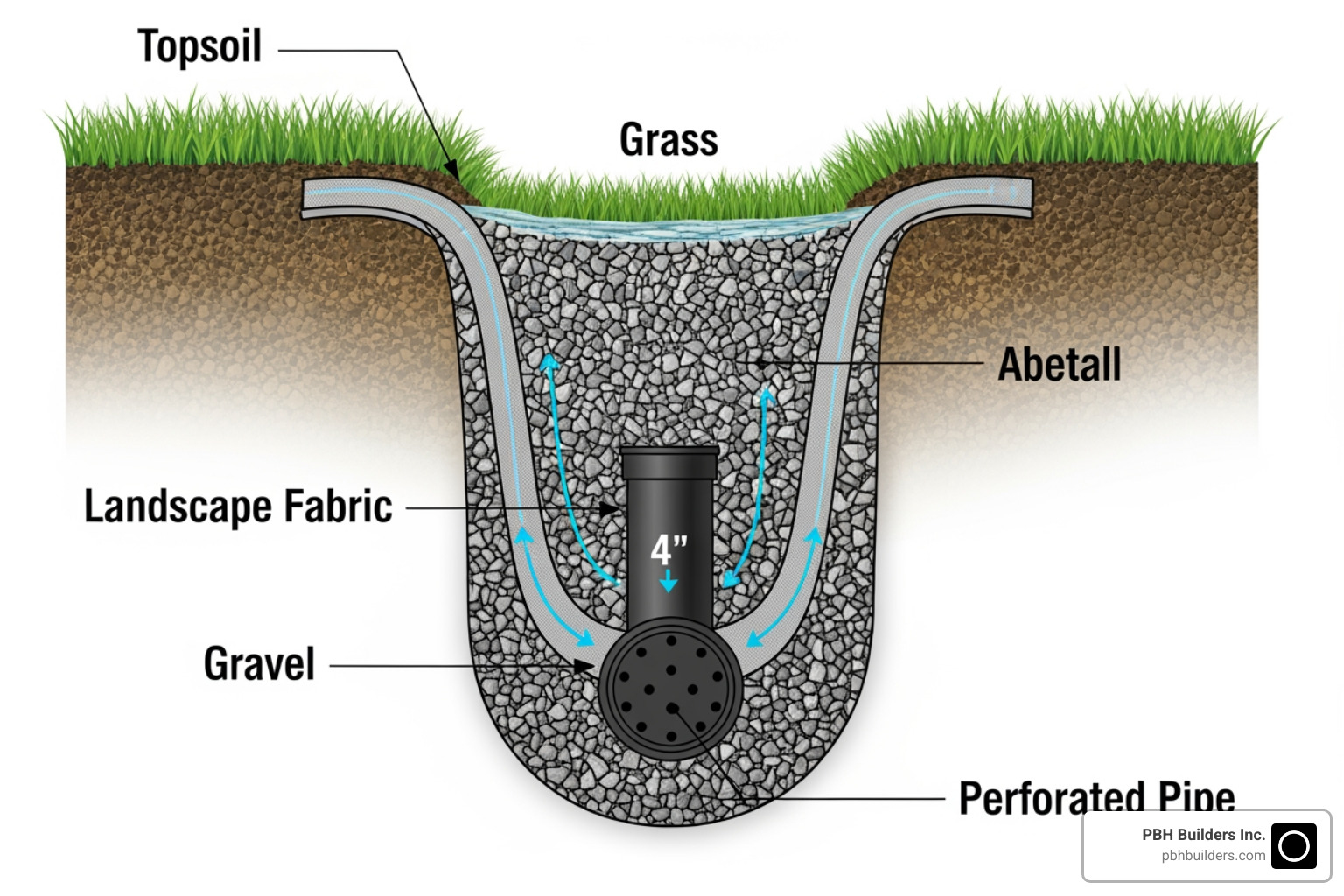
Subsurface systems work unseen underground. The French drain is a popular solution consisting of a gravel-filled trench with a perforated pipe that collects and carries away groundwater. It’s highly effective for protecting foundations and eliminating wet spots, especially in clay soils. Catch basins are grated boxes at low points that collect surface water and debris, directing it into underground pipes. Dry wells are underground chambers that store runoff and allow it to slowly percolate into the soil, a great option for areas with permeable soil. For more info, see this [general info about dry wells](https://www.angi.com/articles/dry-well-installation-cost.htm).
Sustainable & Aesthetic Landscape Drainage Systems
Eco-friendly options can solve water problems while enhancing your landscape. Rain gardens are planted depressions that capture runoff, allowing native plants to absorb water while filtering pollutants. They create beautiful habitats for pollinators with plants like [swamp milkweed](https://www.amazon.com/Seed-Asclepias-incarnata-Pollinated-Needs/dp/B07DSPXLHN/ref=sr_1_1_sspa?crid=3JADSXCA02Y7&dib=eyJ2IjoiMSJ9.pp-JRX_4a8HADYajurpBKNkOtLymdvwB4OWJVV_HPAudITRI_ZYZ_WSrykwAtdvMpYP5EkNNqVr6uo_e8XIYhSK5DlOsexiqmUPzXFWBkRgCXNIjeN6i233V948zAQaeS9XjiJVNn-XbAARtlQcUmZUDicxnIBTX0qW4zoVE2QE8OEZ6_qsXlmE3WYILXhGhv_3y7IZDDP8.cEC33Wm9o4lVzR8afKzvO7rD6hZ4ib7nAUs7ga7Ls_c&dib_tag=se&keywords=milkweed&qid=1721673886&sprefix=milkweed%2Caps%2C98&sr=8-1-spons&sp_csd=d2lkZ2V0TmFtZT1zcF9hdGY&psc=1) and [blue flag iris](https://www.amazon.com/Seed-Needs-Planting-missouriensis-Package/dp/B0B66FYFT1/ref=sr_1_3?crid=3IUWY6ILSLHIN&dib=eyJ2IjoiMSJ9.3l1DhQohO5sQ-80t-mTp_VCG75mUj1zqu-2lGTgYz6IHefJOdPcK_nsUSi995RD_L98Wzi_LF_B6VvVcj3_8WkQhkdI5dHx2TYvBQnWxc7MR1Vwlm3GRs-GK8JI9eLfoTgupLKSF2yStZTMX0oANwHNw6KXuEyUBiykpft66lcM9mc8oz3-yEgyrGEJH6Mpx7iS41vKEOZw3aYLNckFT38eEYYLNLI_tCAufOfKgZhXZhAlKFXFrgo2b20M4WnEMDv6UeN7jp61Vt6Kg-uPY9zyEo6PixJTlHiNWhJLA.0_aV_xQzBDPi7NNtce4-GjWLJcAUWP2p-hEQjcZ0UgE&dib_tag=se&keywords=blue+flag+iris+seeds&qid=1721673957&sprefix=blue+flag+iris%2Caps%2C106&sr=8-3). Permeable pavers offer a durable surface for patios and driveways while allowing water to soak into the ground, dramatically reducing runoff. The EPA explains the benefits of [incorporating pervious paving](https://www.epa.gov/soakuptherain/soak-rain-permeable-pavement). As experienced [San Diego Paver Installers](https://pbhbuilders.com/blog/san-diego-paver-installers/), we can help you select the right permeable options.
DIY Installation: How to Build a French Drain
For the dedicated DIYer, installing a French drain can be a rewarding and cost-effective project. While labor-intensive, it offers a direct solution to soggy, unusable spots in your yard. A basic installation can often be completed for under $100 in materials.
1. Call 811 Before You Dig. This is a non-negotiable first step. This free service marks underground utility lines to prevent a dangerous and expensive accident.
2. Plan Your Trench. Your French drain should run from the highest point of the problem area to a suitable discharge point, like a dry well or a lower part of your property, ensuring water flows away from all structures.
3. Dig the Trench. The trench should be at least 22 inches deep and 14 inches wide. Critically, it must maintain a consistent downward slope of 1/8-inch for every foot of length to ensure water flows properly. Use a level to check the slope as you dig.
4. Install Fabric and Gravel. Line the trench with heavy-duty landscape filter fabric, leaving excess to fold over later. This prevents silt from clogging the pipe. Add a 4-inch layer of clean, washed gravel to the bottom.
5. Lay the Pipe. Place a 4-inch diameter perforated PVC pipe on the gravel bed with the holes facing down. This allows groundwater to enter from below. Use PVC fittings to connect pipe sections securely.
6. Cover and Backfill. Cover the pipe with 4-6 inches of gravel. Fold the excess landscape fabric over the top of the gravel to create a protective barrier. Finally, backfill the trench with at least 9 inches of soil, sod, or decorative rock.
The discharge end can daylight above ground or connect to a dry well. Ensure the water outlet is far from any foundation and won’t cause new erosion problems. For more guidance, This Old House offers excellent information on [Best Drainage Systems To Deal with Stormwater](https://www.thisoldhouse.com/driveways/21018862/best-drainage-systems-to-deal-with-storm-water).
When to Call a Professional for Drainage Issues
While DIY projects are great, some drainage problems require a professional. Knowing when to call for expert help is a smart decision that protects your property and ensures the job is done right.
Consider hiring a professional for:
- Severe or persistent flooding that turns your yard into a lake or threatens to enter your home. These situations often require a comprehensive, multi-faceted solution.
- Complex grading that involves moving large amounts of earth or altering slopes near your foundation. Professionals have the equipment and expertise to get the grade right.
- Any water issue threatening your foundation. This is an emergency. Foundation damage is expensive, and professionals can quickly diagnose the right solution to protect your home’s structural integrity.
- Large-scale projects that combine multiple drainage components. A professional can ensure all systems are properly sized, sloped, and integrated to work together harmoniously.
In San Diego, many advanced landscape drainage systems require permits. A professional contractor will steer local regulations and ensure your project is up to code. When selecting a contractor, look for licensed professionals with specific experience in drainage solutions, and ask for references and warranties.
For projects combining drainage with structural elements like retaining walls, professional expertise is even more critical. Learn more about how we approach these complex projects with our [Retaining Wall Installers](https://pbhbuilders.com/blog/retaining-wall-installers/) services. Hiring a pro saves you time and provides peace of mind that the job is done correctly the first time.
Frequently Asked Questions about Landscape Drainage
Here are answers to the most common questions we hear from San Diego homeowners about landscape drainage systems.
What is the best gravel to use for yard drainage?
For most drainage projects like French drains, pea gravel (1/8 to 3/8 inch) is an excellent choice. Its smooth, rounded shape allows water to flow freely. Crushed stone (#57 stone, 1/2 to 1 inch) is another solid option, as its angular shape locks together for stability. The most important factor is using “clean,” washed gravel free of silt or clay, which can clog your system.
How much slope does a yard need for good drainage?
The industry standard is a minimum slope of 1-inch per foot extending at least 10 feet away from your home’s foundation. This gentle grade is enough to pull water away from your house via gravity. You can check your slope with a 4-foot level and a straight 2×4; over a 4-foot span, you should see a 4-inch drop.
Can rocks help with drainage?
Yes, rocks are a powerful and attractive drainage tool. Dry creek beds, which are shallow trenches filled with river rock, can channel water away during a storm and serve as a beautiful landscape feature when dry. You can also use rocks to create decorative splash blocks under downspouts to prevent erosion and direct water flow. On slopes, strategically placed rocks can slow runoff and hold soil in place.
Conclusion
Effectively managing water in your yard is about more than just avoiding puddles—it’s about protecting your home’s foundation and preserving your landscape. Landscape drainage systems are a critical investment in your property’s value and longevity. From simple DIY fixes to comprehensive professional installations, the right drainage solution can solve frustrating water problems and improve your property.
The best solutions often combine multiple approaches, such as optimizing gutters, correcting the grade, and installing a French drain or rain garden. It’s all about finding the right combination for your unique property.
At PBH Builders Inc., we have years of experience in water management for San Diego’s unique climate and terrain. We understand how to work with clay soil, sloped lots, and tricky wet spots. Our goal is to create solutions that not only work but also improve your entire outdoor living experience.
We’d love to help you transform your waterlogged yard into the beautiful, functional space you’ve been dreaming about. Whether you need a complete drainage overhaul or want to integrate smart water management into a larger landscape renovation, we’re here to bring your vision to life. Let’s work together to [create beautiful and functional outdoor living spaces](https://pbhbuilders.com/services/outdoor-living-spaces/) that you’ll enjoy for decades to come.