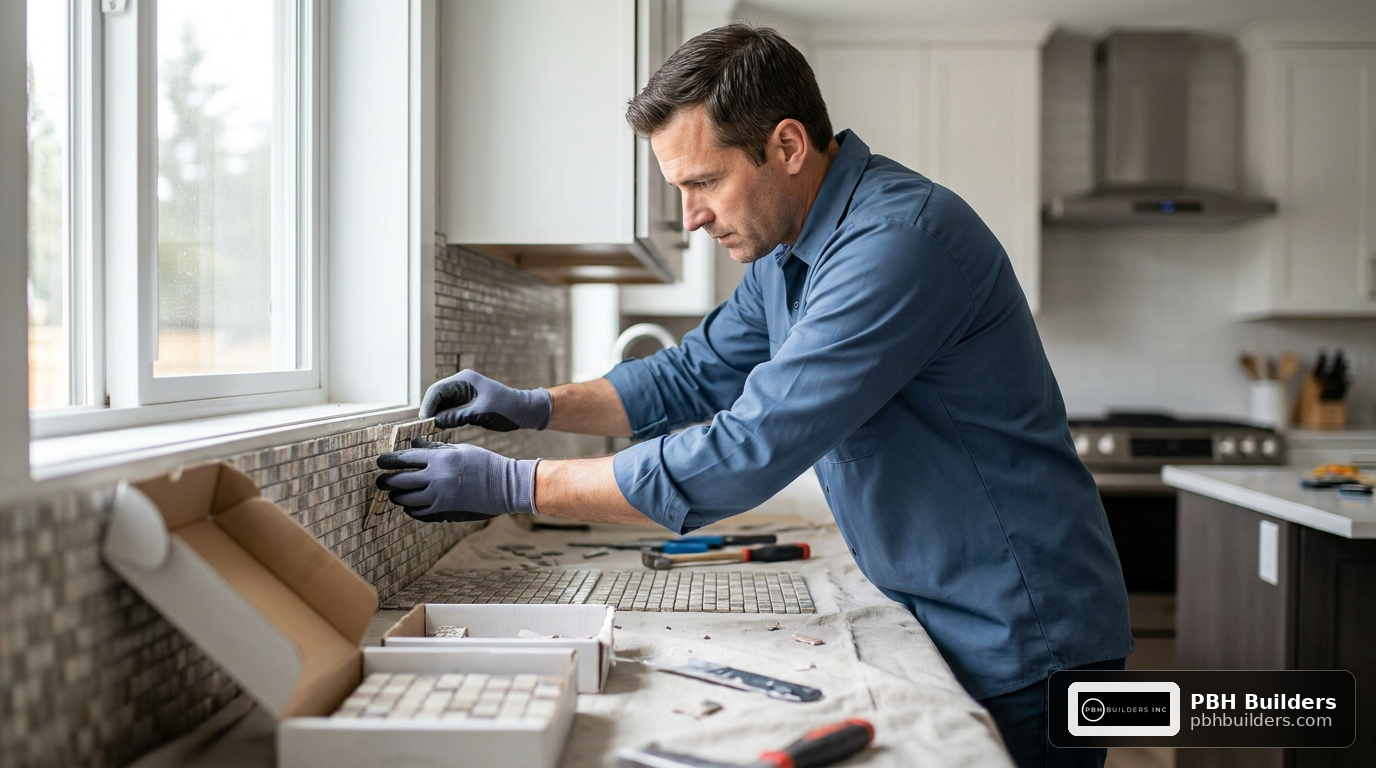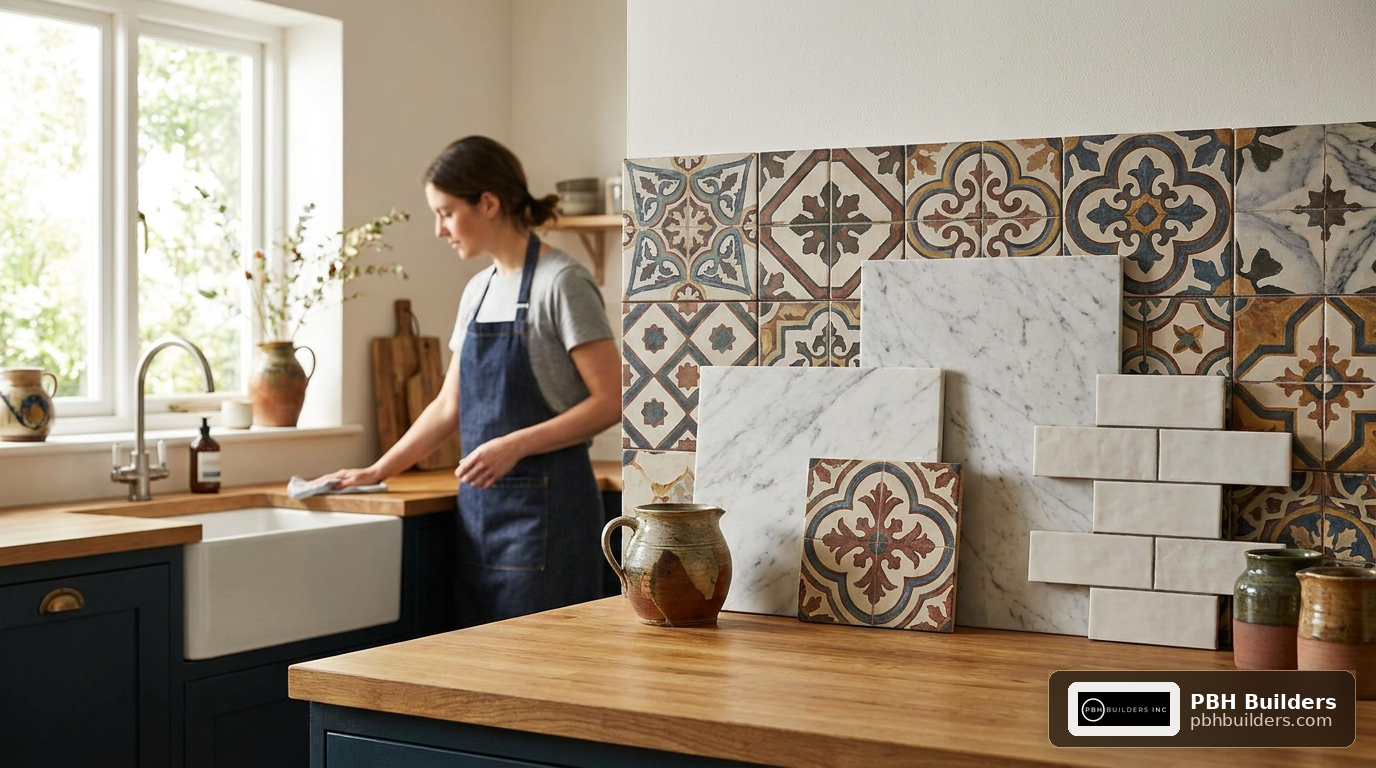
Quick Answer
The best kitchen backsplash material depends on your budget, heat exposure, and maintenance tolerance: porcelain and ceramic tile offer the best durability-to-cost ratio, natural stone and slab backsplashes deliver the strongest design impact, and glass or metal mosaics suit accent areas. Full-height slab backsplashes and warmer, textured tile are the dominant 2026 trends, but the right choice comes down to how the surface will be used day to day, not just how it photographs.
Why Does Your Backsplash Choice Matter So Much?
A backsplash occupies a small fraction of a kitchen’s square footage, yet it sits directly in the eye line of anyone cooking, entertaining, or walking through the space. That outsized visual role is why kitchen backsplash designs and materials have become one of the most debated decisions in a remodel, right alongside cabinetry and countertops.
It is also one of the most functional decisions you will make. The wall behind a range absorbs heat, grease, steam, and acidic splatter every single day, so a material chosen purely for looks can fail fast if it was never meant for that environment. According to the NKBA/KBIS 2026 Kitchen Trends Report, 60% of surveyed designers now identify the backsplash as a primary location for statement color, putting it ahead of decorative accessories at 55% and on par with wallpaper at 60%.
That shift from “protective strip” to “design feature” changes the calculus entirely. A backsplash meant to carry the room’s personality needs to be evaluated differently than one meant to quietly do its job behind a cooktop for 30 years.
What Are the Main Backsplash Materials, and How Do They Compare?
Every backsplash material trades off differently across durability, heat tolerance, maintenance, and cost. Porcelain, ceramic, natural stone, and slab surfaces remain the most practical choices, while glass, metal, and peel-and-stick products fill specific design or budget niches.
| Material | Estimated Lifespan | Best Suited For |
|---|---|---|
| Porcelain tile | 50+ years | High-heat zones, busy kitchens, long-term ownership |
| Ceramic tile | 25-30 years | Budget-conscious remodels, color/pattern variety |
| Quartzite / natural stone slab | Decades, with sealing | Full-height statement walls, matching countertops |
| Glass/metal mosaic | Varies, moderate | Accent strips, low-heat areas, bold color pops |
| Peel-and-stick | 3-5 years | Rentals, temporary updates, away from heat sources |
Porcelain’s appeal comes down to chemistry: impervious porcelain tile absorbs less than 0.5% water, which is a major reason one design industry estimate puts its realistic service life at 50 years or more under proper installation. Ceramic tile, while softer and more porous, still performs well for a typical 25 to 30 year stretch when installed correctly. Peel-and-stick products are useful for budget refreshes but are not recommended directly behind ranges or cooktops, since heat and grease shorten their 3 to 5 year expected lifespan even further.
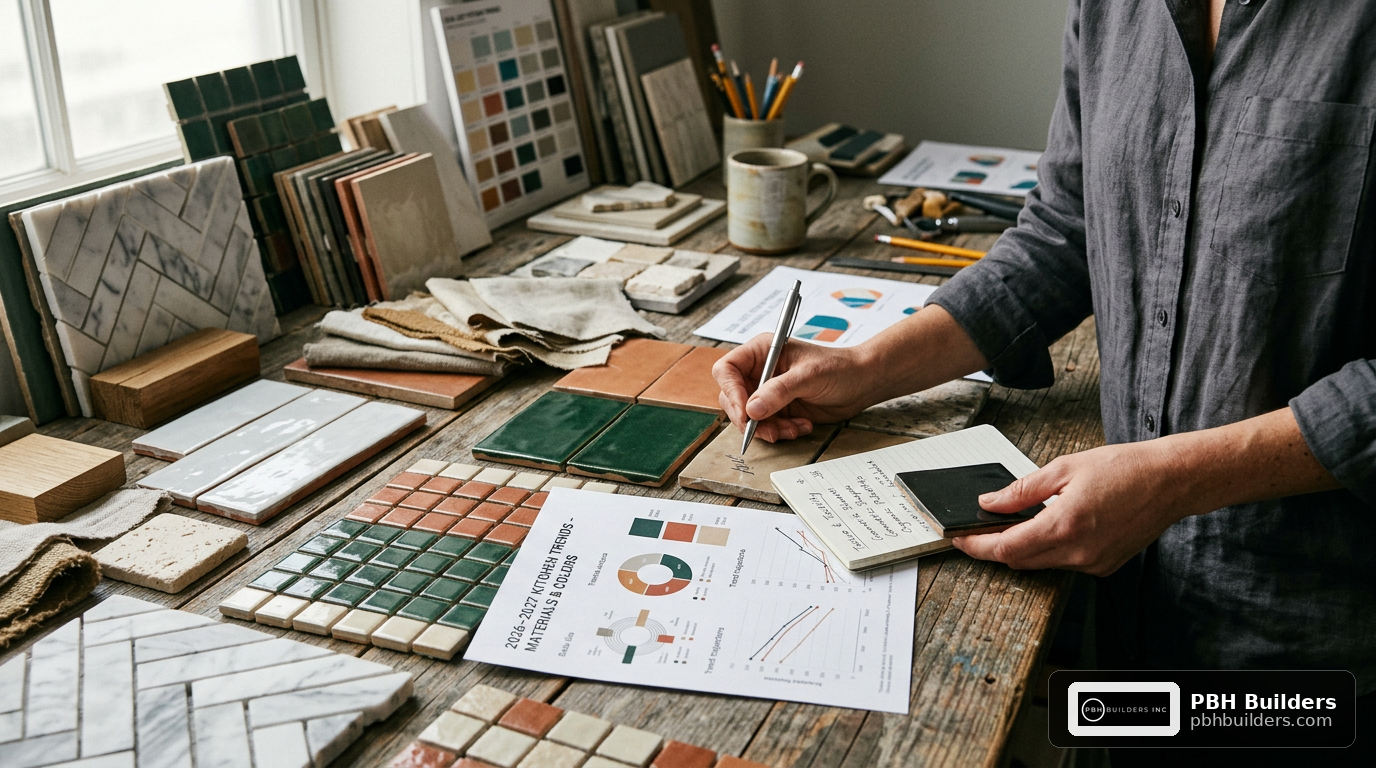
What Backsplash Styles Are Trending in 2026?
Design direction in 2026 is moving away from busy patchwork tile layouts and toward calmer, more continuous surfaces. The clearest signal comes from the NKBA/KBIS data: 75% of surveyed industry respondents identified slab or solid-surface backsplashes as a rising category, and natural quartzite is now reported at 61% popularity for backsplashes and 62% for countertops, trailing only quartz itself.
Full-height slabs that run from the countertop to the underside of cabinets, a range hood, or even the ceiling are driving much of this shift. Designers interviewed by Houzz’s roundup of favorite backsplash styles point to dramatic veining and fewer grout lines as the draw, while coverage from Homes & Gardens’ 2026 backsplash trend analysis notes a parallel move toward warmer tones and handcrafted, slightly irregular tile finishes rather than perfectly uniform surfaces.
One 2026 market summary estimates that slab backsplashes now represent roughly 28% of renovated U.S. kitchen backsplashes, though that figure should be read with some caution since the underlying survey methodology isn’t fully documented. The same source reports that 86% of homeowners and designers favor neutral palettes overall, with green and blue leading accent color choices at around 78%, and that backsplashes reaching at least to the underside of cabinets have climbed to roughly 78%, up from 62% in an earlier comparison period.
Not every kitchen needs a slab, though. Handcrafted zellige-style ceramic, textured subway variations, and warm-toned mosaic patterns remain strong choices for kitchens where a full-height stone wall would overwhelm the room or the budget. Architectural Digest’s backsplash idea collection highlights how smaller-format tile can still deliver a high-end look when paired with thoughtful grout color and layout.
How Much Does a Kitchen Backsplash Cost, and Why?
Backsplash pricing varies widely because it depends on material, square footage, pattern complexity, and labor conditions, not just the price per tile. Reported 2026 figures give a useful starting point, but actual project costs should always be confirmed with a detailed quote.
- Quartz or quartzite slab backsplashes: often reported in the range of $100 to $150 or more per square foot installed, reflecting material cost, fabrication, and the skilled labor required for seamless seams and precise cutouts.
- Glass or metal mosaic tile: commonly falls between roughly $18 and $55 per square foot, depending on pattern intricacy and whether metal accents are hand-set.
- Porcelain and ceramic tile: pricing swings broadly based on tile quality, format size, and whether a pattern like herringbone or hexagon is specified, since intricate layouts significantly increase labor time.
- Peel-and-stick products: typically the lowest cost option, often cited around $4 to $8 per square foot, but with real limitations near heat sources and a much shorter usable life.
In practice, pricing for any kitchen backsplash project varies based on your specific project: the complexity of the layout, the wall’s existing condition, electrical and plumbing obstacles around outlets and windows, and whether the material needs edge finishing, full-slab fabrication, or waterproofing behind the cooktop. A simple subway tile accent will always cost less than a book-matched quartzite slab that wraps a hood and runs to the ceiling, and that gap is almost entirely about material and fabrication complexity rather than labor rate alone. The most reliable way to understand what your kitchen will cost is a detailed, on-site custom quote rather than a generic per-square-foot number pulled from a national average.
Coverage: Counter-to-cabinet strip
Tradeoff: Lower upfront cost, shorter lifespan vs. porcelain
Coverage: Full height behind range
Tradeoff: Strong durability, more install labor
Coverage: Full wall, matched to countertop
Tradeoff: Highest cost, maximum visual impact
What Questions Should You Ask Before Choosing a Material?
A good contractor or designer should walk you through trade-offs before you commit to a material, not after tile is already ordered. Bring these questions to any consultation:
- How much direct heat and grease will this wall see? A range wall needs a different material than a wall behind an open shelving display.
- Does this material require sealing, and how often? Natural stone and some porous tile need periodic resealing to resist staining.
- What happens at outlets, corners, and the transition to the hood? Ask to see how edges and cutouts will be finished, especially on slab installations.
- Is the tile rated for impervious water absorption, or is it a more porous body? This affects long-term staining and grout maintenance.
- What is the realistic lead time for this material? Slab fabrication and imported tile can add weeks to a project timeline.
- How will this look against my existing or planned countertop? Matching veining between countertop and backsplash slabs requires careful slab selection, not just matching material names.
What Red Flags Signal a Backsplash Project Gone Wrong?
Most backsplash failures trace back to installation shortcuts rather than the material itself. Watch for these warning signs when evaluating a quote or an installer:
- No mention of substrate preparation. Tile and slab both require a flat, properly prepped wall; skipping this step causes cracking and uneven grout lines later.
- Vague answers about sealing natural stone. If a quote doesn’t specify sealant type and reapplication schedule, staining risk goes up significantly.
- Unusually low bids on slab work. Full-height quartzite or marble installs require specialized fabrication; a bid far below the $100 to $150+ per square foot range reported industry-wide should prompt questions about material thickness or installer experience.
- No plan for electrical outlet cutouts. Poorly cut outlet boxes in tile or slab are one of the most common visible defects in finished kitchens.
- Peel-and-stick proposed directly behind a range. This is a known heat-tolerance mismatch that shortens the product’s already limited 3 to 5 year lifespan.
For more on how professionals are navigating these choices, Good Housekeeping’s 2026 backsplash trend coverage and House Digest’s rundown of 2026 backsplash trends both emphasize that installation quality, not just material selection, determines how a backsplash performs over time.
How Do You Choose the Right Backsplash for Your Kitchen?
Start by defining the job the backsplash needs to do. If it sits directly behind a range and needs to survive daily grease and steam for decades, porcelain or a well-sealed natural stone slab makes more sense than a trend-driven material chosen for photos alone.
If the goal is a design statement in a lower-heat zone, such as an open shelving wall or a bar area, there is more room to experiment with glass mosaic, bold color, or handcrafted ceramic. Matching the backsplash material to its actual exposure, rather than to the newest trend, is the single biggest factor in long-term satisfaction.
- Full-height slab backsplashes are gaining significant traction, with 75% of industry respondents citing them as a rising trend in the NKBA/KBIS 2026 report.
- Porcelain tile offers the strongest durability-to-cost ratio, with under 0.5% water absorption and an estimated 50+ year service life.
- Natural quartzite now ranks just behind quartz in popularity for both backsplashes (61%) and countertops (62%).
- Neutral palettes dominate at an estimated 86%, with green and blue as the leading accent colors at roughly 78%.
- Peel-and-stick products are budget-friendly but unsuitable for direct heat exposure, with a realistic lifespan of only 3 to 5 years.
- Pricing varies enormously by material and complexity, so a detailed, project-specific quote is far more useful than a generic average.
- Installation quality, including substrate prep and sealing schedules, matters as much as material choice for long-term performance.
People Also Ask
What is the most durable material for a kitchen backsplash?
Porcelain tile is generally considered the most durable option, with water absorption under 0.5% and an estimated service life of 50 years or more when properly installed. Natural stone slabs can last just as long but require regular sealing to maintain that performance.
Is a full-height slab backsplash worth the extra cost?
For kitchens aiming for a strong design statement, many homeowners find the continuous look worth the investment, which is why 75% of NKBA/KBIS survey respondents identified slab backsplashes as a rising trend. Whether it’s worth it for your specific kitchen depends on your budget priorities and how long you plan to stay in the home.
Can I install peel-and-stick tile behind my stove?
It’s not recommended. Peel-and-stick products are generally unsuitable for direct heat exposure and have a realistic lifespan of only 3 to 5 years, far shorter than porcelain or ceramic tile.
What colors are most popular for kitchen backsplashes right now?
Neutral palettes remain dominant, favored by an estimated 86% of homeowners and designers, with green and blue leading accent color choices at roughly 78%. Warmer tones and handcrafted, slightly irregular finishes are also gaining ground in 2026.
Does natural stone need to be sealed for backsplash use?
Yes. Natural stone like marble and quartzite is porous and needs periodic sealing to resist staining from grease, acidic splatter, and moisture. Ask your installer for a specific sealing schedule before committing to the material.
Frequently Asked Questions
How much does a kitchen backsplash cost?+
Costs vary widely depending on material, square footage, and layout complexity, with reported ranges from roughly $4 to $8 per square foot for peel-and-stick up to $100 to $150 or more per square foot for slab stone. Pricing varies based on your specific project, so a detailed quote is the most accurate way to budget.
What is the difference between porcelain and ceramic backsplash tile?+
Porcelain is denser and less porous, with under 0.5% water absorption and an estimated 50+ year lifespan, while ceramic is more affordable but typically lasts 25 to 30 years. Both perform well, but porcelain is the stronger choice for heavy-use areas directly behind a range.
Should my backsplash match my countertop?+
Matching countertop and backsplash material, especially with quartzite or marble slabs, is a leading 2026 trend and creates a cohesive, continuous look. It isn’t required, though; many kitchens pair a stone countertop with a contrasting tile backsplash for visual interest.
How high should a kitchen backsplash go?+
Backsplashes reaching at least to the underside of the cabinets are now common, reported at roughly 78% of installations, up from about 62% previously. Full-height designs that run to a range hood or ceiling are an increasingly popular upgrade for a cleaner, more continuous look.
Are glass or metal mosaic backsplashes a good choice?+
Glass and metal mosaics, typically priced around $18 to $55 per square foot, work well as accent features in lower-heat areas but are less practical as the sole material directly behind a range. Many designers use them as a feature strip paired with a more heat-tolerant primary material.
How long does a professionally installed backsplash last?+
With proper substrate prep, sealing, and care, porcelain backsplashes can last 50 years or more, ceramic around 25 to 30 years, and peel-and-stick products only 3 to 5 years. Actual longevity depends heavily on installation quality, heat exposure, and ongoing maintenance.