Your Guide to San Diego Landscapes and Retaining Walls
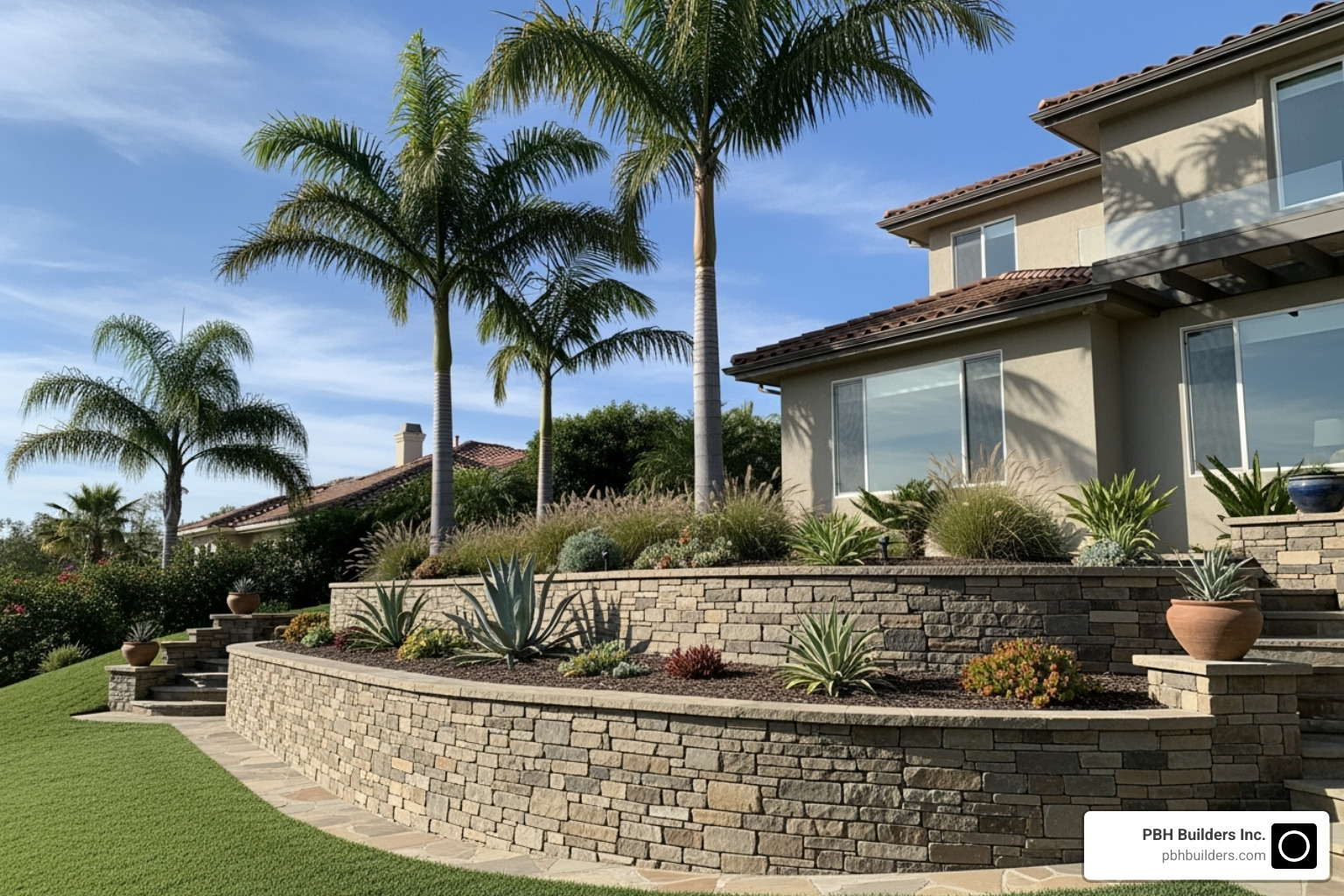
A San Diego retaining wall often requires a building permit. San Diego’s hillside properties and sloped terrain make retaining walls essential for preventing soil erosion, creating usable flat space, and managing water runoff. However, building one isn’t as simple as stacking blocks. The City of San Diego has specific regulations to ensure your wall is safe and structurally sound. Understanding these rules saves you from costly mistakes and fines.
Quick Permit Requirements:
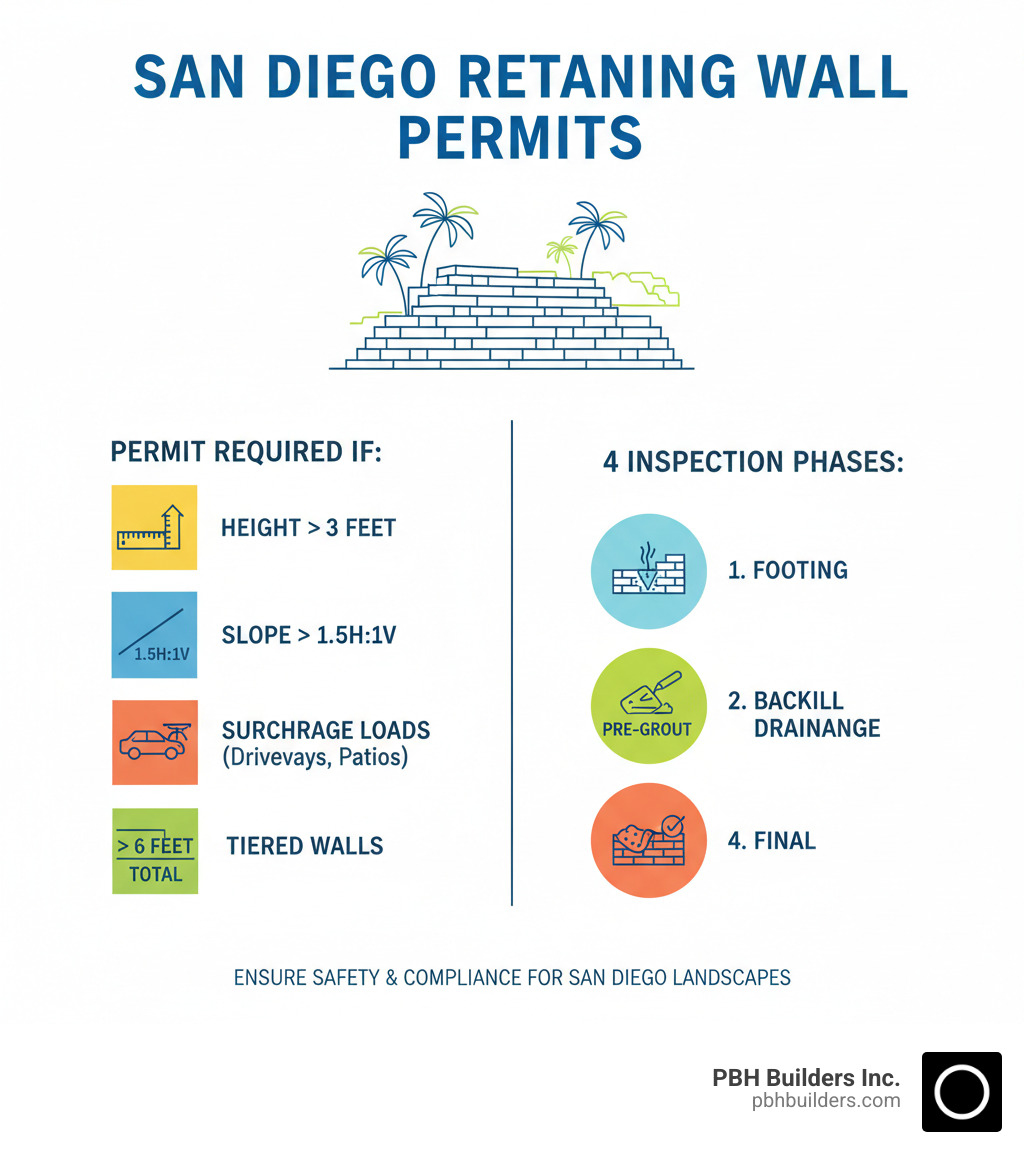
- Height over 3 feet (measured from top of footing to top of wall) – Permit required
- Steep slope support (1.5H:1V or steeper) – Permit required
- Surcharge loads (driveways, walkways, structures) – Permit required
- Tiered walls (combined height over 6 feet) – Permit required
- Walls over 5 feet – May also require grading permit
This guide covers the essential permits, materials, and regulations for building a retaining wall in San Diego, whether you’re creating terraced gardens or leveling a sloped yard.
Easy San Diego retaining wall word list:
Why Retaining Walls are Essential in San Diego
San Diego’s diverse topography presents challenges for property owners. A well-designed San Diego retaining wall is a critical structural necessity that open ups the full potential of your outdoor space. Here’s why they are so essential:
- Taming the Terrain: On sloped properties, a robust retaining wall prevents the natural downhill movement of earth, holding back soil that would otherwise erode or shift. This is vital for hillside properties where soil stability is a concern.
- Preventing Soil Erosion: Retaining walls dramatically reduce soil erosion caused by heavy rains and dry spells, protecting your topsoil and landscaping investments.
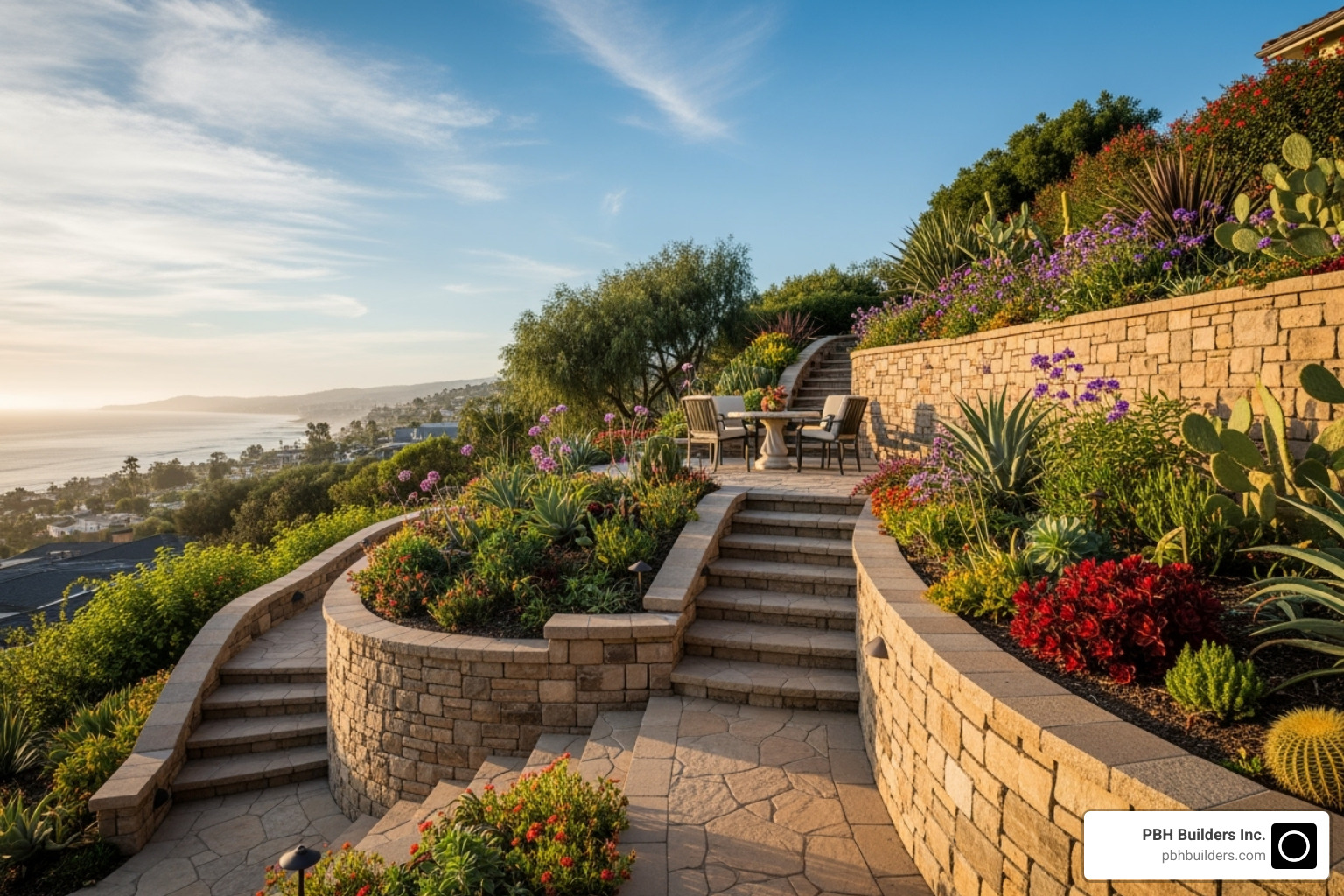
- Creating Usable Land: A retaining wall can transform a steep, unusable slope into a multi-tiered garden, a spacious patio, or a level lawn, effectively extending your property’s footprint for more versatile outdoor living.
- Managing Water Runoff: Walls with integrated drainage systems direct stormwater away from your home’s foundation, preventing pooling and mitigating damage during heavy downpours.
- Enhancing Landscape Aesthetics: Retaining walls are powerful design elements that define spaces and add visual interest. They can be built from various materials to complement your home’s architectural style.
A retaining wall in San Diego provides peace of mind by protecting your property and optimizing it for your lifestyle. We invite you to learn More info about our retaining wall services and see how we can transform your landscape.
Signs Your Retaining Wall Needs Professional Attention
Even a robust San Diego retaining wall can weaken over time due to weather and soil pressure. Ignoring warning signs can lead to erosion, property damage, or collapse. Catching issues early saves expense and stress. Here are signs that your wall needs professional help:
- Cracks (Vertical, Horizontal, or Stair-Step): While fine hairline cracks can be normal, growing cracks wider than a quarter-inch are red flags. Vertical cracks suggest excessive lateral pressure, horizontal cracks indicate internal pressure, and stair-step cracks often point to foundation movement.
- Leaning or Tilting: A wall leaning away from the retained soil is a clear sign that the pressure behind it is too great, indicating a failure in the wall’s design or construction.
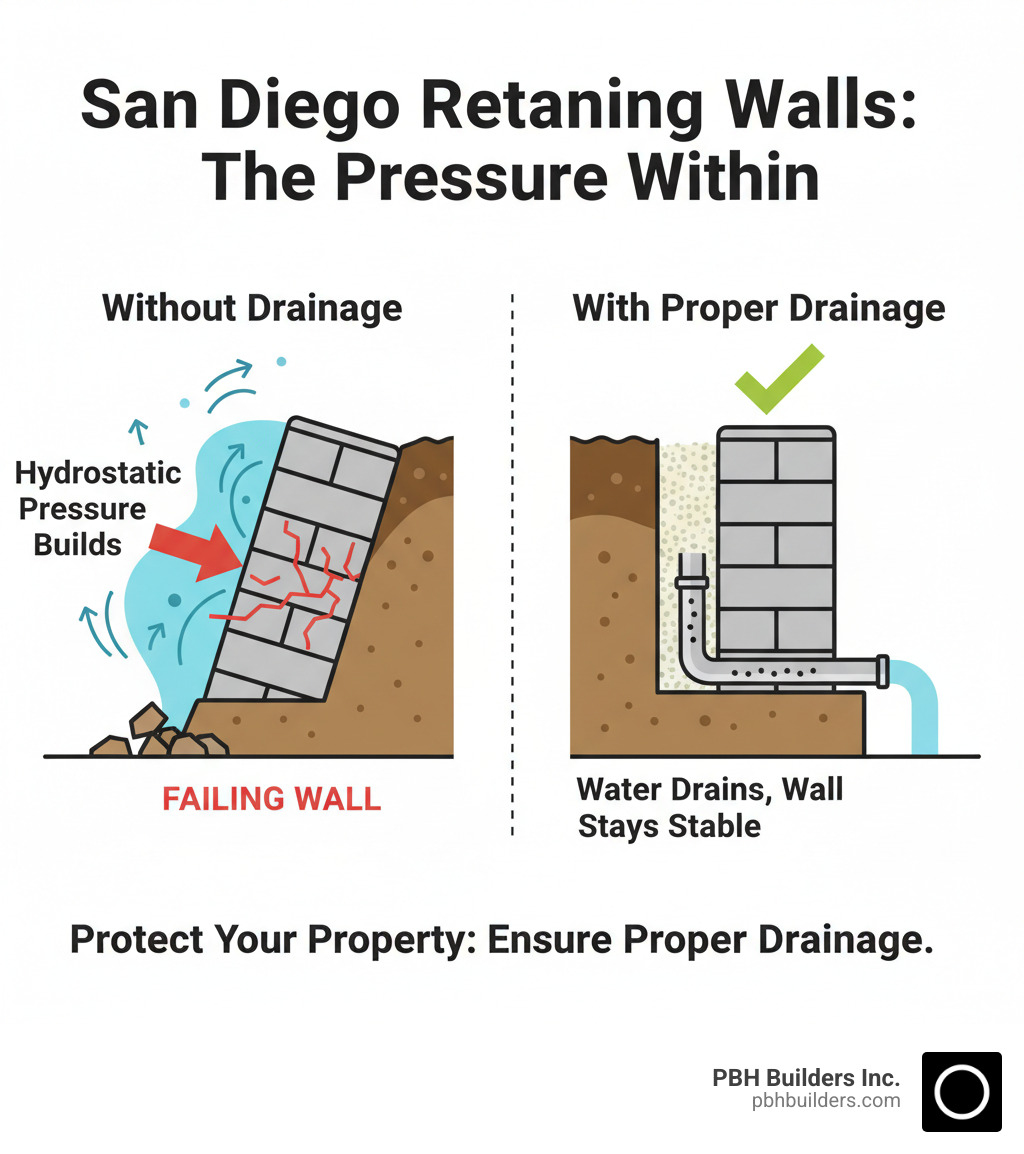
- Bowing or Bulging: Outwardly bulging sections mean the wall is deforming under immense pressure, often due to failed drainage and hydrostatic pressure buildup. A bowed wall is often on the verge of failure.
- Water Damage Signs: Efflorescence (white, powdery deposits), constant dampness, or water streams emerging from the wall indicate inadequate drainage. Water adds immense weight and pressure to the soil behind the wall.
- Separating from Adjacent Structures: If your wall is pulling away from an adjacent structure, it suggests significant movement that can compromise both the wall and the connected structure.
- Shifting or Sinking: Misaligned or sunken blocks indicate foundation issues or soil instability.
If you see any of these signs, act immediately. A DIY fix is risky and can worsen the problem. Our experienced team can assess and repair troubled retaining walls, ensuring your property’s safety.
Your Guide to the San Diego Retaining Wall Permit Process
The permit process for a San Diego retaining wall is a critical safety net for your investment. City and County regulations exist to ensure your wall can withstand tons of earth, seismic activity, and water runoff without failing. Skipping the permit process can lead to hefty fines, mandatory demolition, and the high cost of rebuilding.
More importantly, an unpermitted or improperly built wall is a safety hazard that can cause soil slides and property damage. The permit process ensures qualified professionals review your project and that it’s designed for our unique Southern California environment. At PBH Builders Inc., we have decades of experience guiding clients through this process, making it as straightforward as possible by handling the technical details for you.
When is a Building Permit Required?
You need to know if your planned San Diego retaining wall requires a permit. Height is a major factor, but other conditions also trigger the requirement.
A permit is needed if your wall is over three feet tall, measured from the top of its footing to the top of the wall. This total structural height matters, not just what’s visible above ground.
A permit is also required if the soil behind your wall slopes steeply (1 foot vertical drop for every 1.5 feet horizontal, or a 1.5H:1V slope). This steep angle creates enormous pressure that demands an engineered design, regardless of wall height.
You will need a permit if your wall supports a surcharge load, which is any extra weight on the soil behind it. This includes driveways, patios, walkways, or footings for other structures.
For tiered walls, a permit is required if the combined height from the bottom footing to the top of the highest wall exceeds six feet, even if individual walls are under three feet.
Finally, walls over five feet in height may require a separate grading permit in addition to the building permit. When in doubt, consult with professionals or check the city’s official guidance on How to Obtain a Permit for a Retaining Wall Using the City of San Diego Standard Drawings and Specifications.
Permit Submittal Requirements
Once you’ve determined a permit is needed for your San Diego retaining wall, you must prepare documentation. A clear and complete submittal will speed up the review process.
Your application must include a site plan and vicinity map, a bird’s-eye view showing the wall’s precise location, dimensions, and property lines. The plan must prove the wall, its footing, and drainage components are on your property with proper setbacks. It also needs to detail the footing design, drainage system, existing structures, and land grades.
A retaining wall plan, shown as a cross-section, details the wall’s construction. This includes material specifications for concrete strength, masonry units, mortar, grout, and the size and placement of reinforcing steel (rebar). Drainage components like perforated pipe and gravel backfill must also be specified.
For many standard designs, the City of San Diego’s Information Bulletin 221 provides pre-approved specifications. Incorporating these into your plans can streamline the review.
You will also need to submit standard forms, including the Project Contacts Information Form (DS-345) and, if applicable, the Owner-Builder Verification Form (DS-3042). Plans are typically submitted electronically, and fees are required before review and upon permit issuance. We can handle this entire process, ensuring your project starts on the right foot.
The Four Phases of City Inspection
After your permit is approved, your San Diego retaining wall construction will be verified at key stages through city inspections. These checkpoints are designed to catch problems early, before they are buried. Missing or failing an inspection can halt your project.
- Footing Inspection: This occurs after the trench is dug and rebar is placed, but before concrete is poured. The inspector verifies excavation depth, soil stability, rebar placement, and setbacks. This is critical, as the footing is the wall’s foundation.
- Pre-Grout Inspection: For block walls, this happens after blocks are laid and all rebar is in position, but before grout is added. The inspector checks block alignment, mortar joints, and the reinforcing steel “skeleton.” For poured concrete walls, this is a pre-pour inspection.
- Backfill and Drainage Inspection: This is scheduled after the wall is grouted and the drainage system is installed, but before the final backfill is placed. The inspector verifies the drain pipe, gravel, filter fabric, and backfill material are installed per the approved plans to prevent hydrostatic pressure buildup.
- Final Inspection: Once the entire project is complete, an inspector verifies that the finished wall aligns with the approved plans and all previous conditions have been met. Passing this inspection means your wall is officially approved.
At PBH Builders Inc., we handle all inspection scheduling and coordination, ensuring each phase passes the first time to keep your project moving smoothly.
Design and Material Specifications for Longevity
Building a San Diego retaining wall that lasts requires precision, engineering knowledge, and quality materials suited for California’s conditions. A wall must be engineered to withstand soil pressure, water weight, and seismic activity. This is achieved through careful design, proper reinforcement, and effective drainage. Using substandard materials is a recipe for failure, which is why we never compromise on structural integrity or material quality.
Key Considerations for Your San Diego Retaining Wall
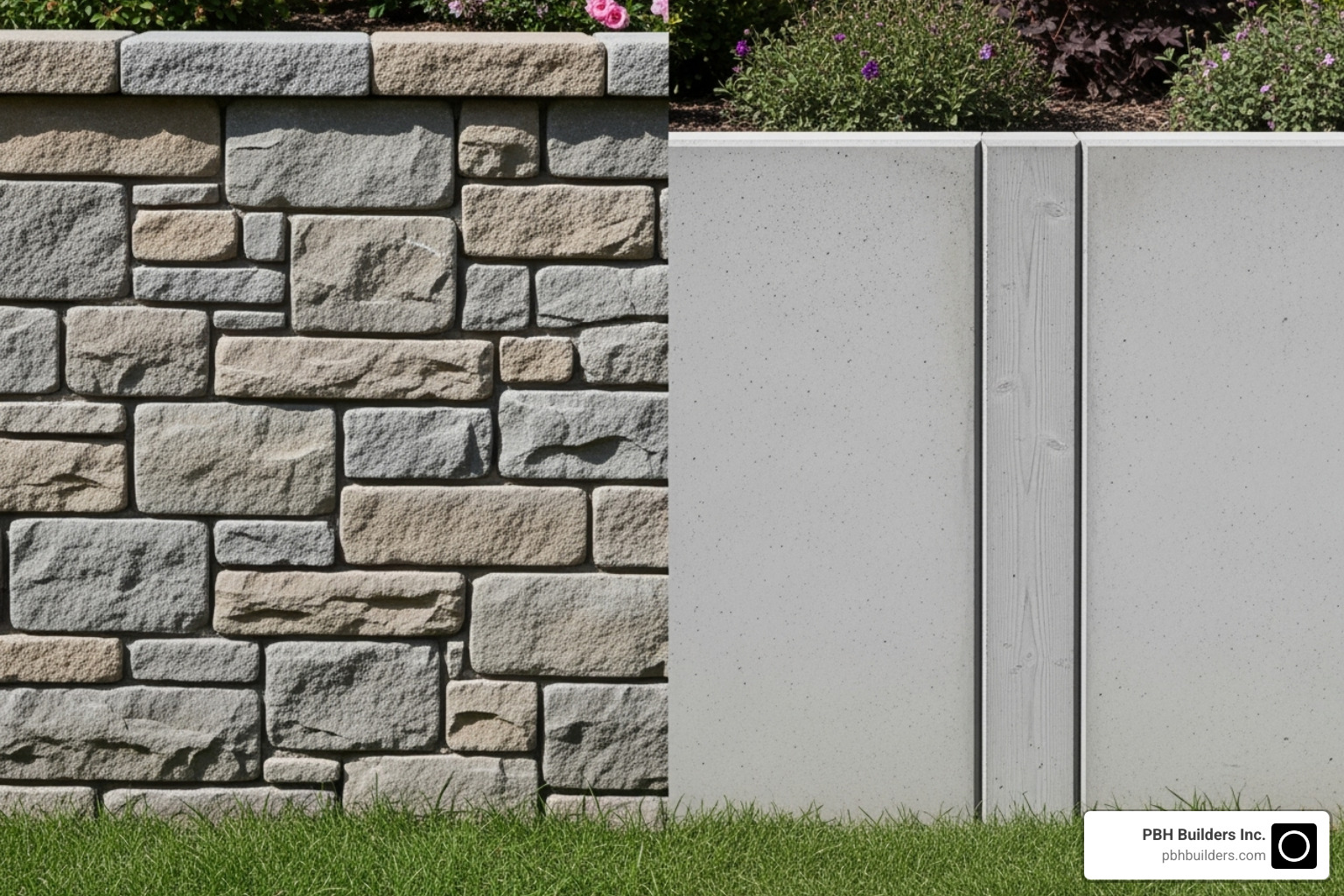
A key decision for your San Diego retaining wall is choosing between block construction and poured concrete. Both are excellent when built correctly, but they have different strengths.
Block walls use concrete masonry units (CMUs) that are stacked, reinforced, and grouted. They are versatile and offer a wide range of aesthetic options in various textures and colors. Poured concrete walls are monolithic structures that are exceptionally strong, making them ideal for taller walls or challenging soil conditions.
Here is a quick comparison:
- Durability: Both are highly durable. Block walls offer more flexibility against minor ground movement, while poured concrete provides superior unified strength.
- Cost: Block walls are often more economical for typical residential projects. Poured concrete can be more expensive due to labor and formwork but may be more cost-effective for very tall or complex walls.
- Aesthetics: Block walls offer greater design flexibility with numerous faces, caps, and colors. Poured concrete can be finished smooth or stamped but has fewer decorative options.
- Installation Speed: Block walls can often be built faster as they don’t require the same curing time as poured concrete.
Many San Diego homeowners choose engineered block systems for their blend of strength, beauty, and versatility. You can see examples of our work to get a sense of what’s possible with both construction types.
Material and Construction Standards
The City of San Diego specifies exact standards for every component of a San Diego retaining wall to ensure safety and performance.
- Concrete Strength: All concrete must have a minimum compressive strength of 3,000 psi to withstand soil pressure.
- Masonry Blocks: Concrete masonry units (CMUs) must meet ASTM C90 standards for strength and dimensional tolerance.
- Mortar and Grout: Type S mortar is typically required for its strength. Grout must be properly placed to eliminate voids and achieve specified compressive strengths.
- Reinforcing Steel: Rebar must be Grade 60, capable of withstanding 60,000 psi of stress. Its size and placement are engineered based on the wall’s design.
- Drainage System: A perforated drain pipe, gravel backfill, and filter fabric are critical to prevent hydrostatic pressure buildup, the leading cause of wall failure.
The city provides detailed requirements in its Standard Cantilevered Retaining Walls specifications. We view these standards as the baseline for quality, ensuring every component meets or exceeds code for a structure that will last for generations.
Build Your San Diego Retaining Wall the Right Way
Building a San Diego retaining wall is a significant undertaking. The key takeaways are clear: permits are essential for protection, following building codes is not optional, and professional expertise makes all the difference. While a small garden wall can be a DIY project, any structural wall requires professional design and construction to handle soil mechanics, drainage, and reinforcement correctly.
A properly built wall is a long-term investment that prevents erosion, creates usable outdoor space, and boosts property value. Investing in quality craftsmanship from the start helps you avoid the high cost of premature failure and reconstruction.
At PBH Builders Inc., we bring over 50 years of combined experience to every retaining wall project. We know San Diego’s landscape, understand the local permitting process, and are passionate about creating outdoor spaces that improve your life. We guide you through every step, from initial consultation to final inspection, handling the details so you can focus on the possibilities.
Your San Diego retaining wall deserves to be built right the first time—structurally sound, beautiful, and fully compliant. When done correctly, you gain peace of mind knowing your property is protected and your investment is secure. Transform your property with expertly designed outdoor living spaces that bring your vision to life.
Ready to get started? Contact us today for a consultation, and let’s turn your challenging slope into your favorite outdoor retreat.